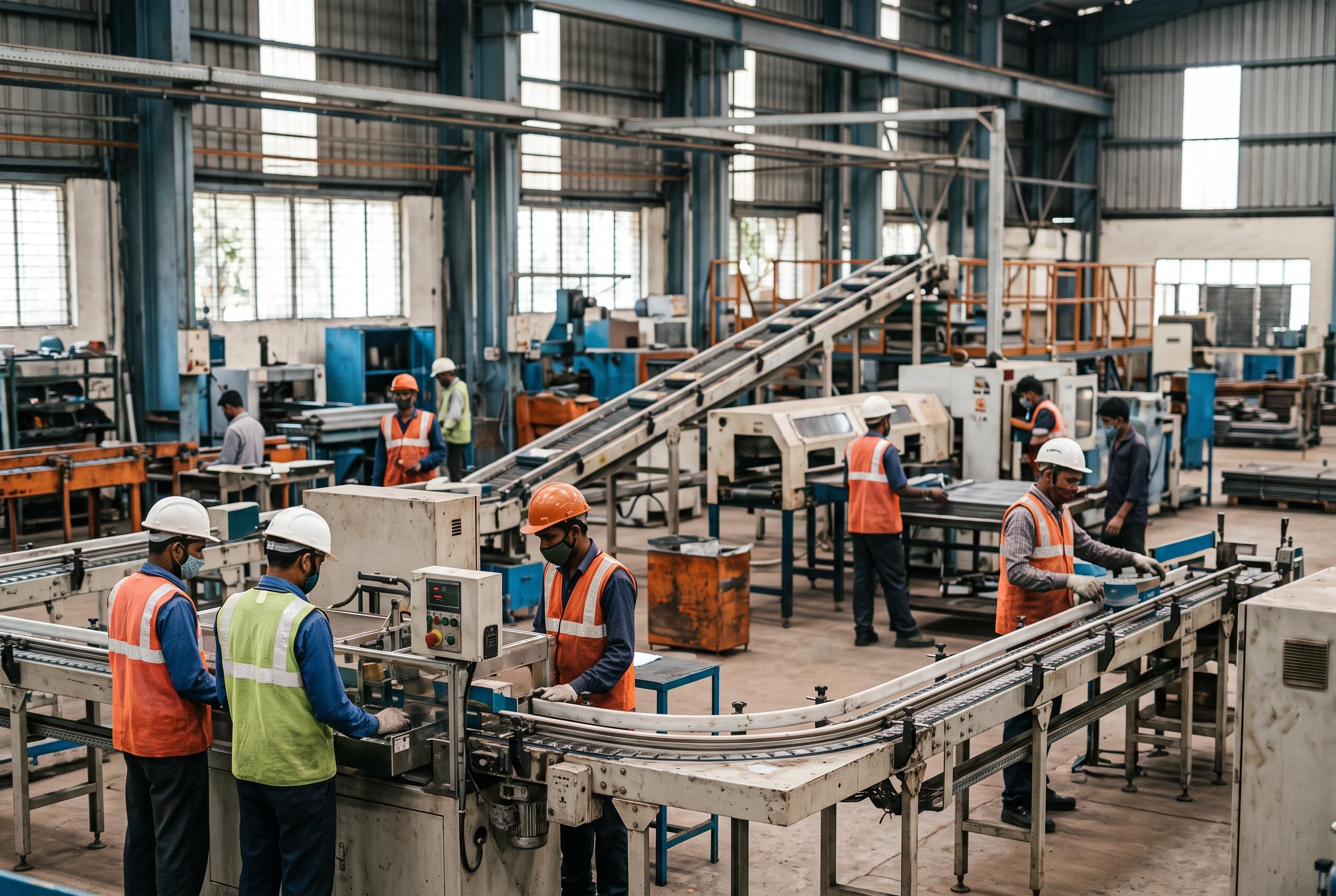

Factories in India increased employment at a record pace in FY25, even as gross fixed capital formation declined for the first time since the pandemic, highlighting a labour-driven recovery with subdued new capacity expansion.
Indian registered factories cut back on new investment in FY25 even as hiring accelerated to a record pace, highlighting a recovery that is still being driven more by labour than by fresh capacity. According to the latest Annual Survey of Industries, gross fixed capital formation fell 8% to ₹63,497 crore, the first annual decline since the pandemic year FY21, after surging 77% in FY23 and 18% in FY24.
The pattern suggests factories have been expanding by putting more people to work in existing plants rather than by building new ones. The survey showed that fixed capital per worker, a rough measure of how much machinery supports each job, rose 3.1% in FY25, about half the pace seen a year earlier. Business Standard reported that the manufacturing sector also added 1.41 million jobs in FY25, pushing total registered factory employment above 20 million for the first time.
Madan Sabnavis, chief economist at Bank of Baroda, told Business Standard that some of the slowdown was likely a base effect after two years of strong capital formation, but he said that did not explain everything. He pointed to weaker private sector spending, especially in consumer goods, where inflation and uneven rural and urban demand had weighed on investment, while noting that capital expenditure in steel, power and other infrastructure-linked industries often comes in bursts rather than on a steady annual basis.
The softer investment backdrop also showed up in productivity. Output per worker slipped 0.4% in FY24 and rose only 0.5% in FY25, making it the second consecutive year of near-flat performance. Business Standard said that was the closest the series has come to two back-to-back years of almost no productivity growth since the survey began in 1981-82, a sharp contrast with the 25.3% rise in FY22 and 13.1% in FY23.
Earnings trends were more balanced. Profit per factory increased 5% in FY25 to ₹4.33 crore, while wages per worker rose 5.3% to ₹2.28 lakh. That reversed FY24, when profits had grown faster than pay, a gap that the Economic Survey 2024-25 had also highlighted. The difference between the two has narrowed markedly in recent years, after a period in which profits surged far ahead of wages in the immediate post-pandemic rebound.
Wage growth, however, was not uniform across states. Business Standard reported that Sikkim, Tripura, Bihar, Chhattisgarh and Telangana recorded increases above the national average of 4.6% in emoluments per person engaged. On productivity, Odisha remained the leading state, with output per person engaged of ₹1.42 crore, followed by Sikkim, Chhattisgarh, Jharkhand and Gujarat. Earlier ASI data also showed manufacturing GVA rising 11.89% in FY24, underlining that the sector’s output performance has remained stronger than its investment trend even as factories have leaned more heavily on labour.
Disclaimer: This article is intended to inform and educate, not to recommend or endorse any financial product, investment or strategy. Please consider your own financial circumstances and seek professional advice where appropriate before making financial decisions.