

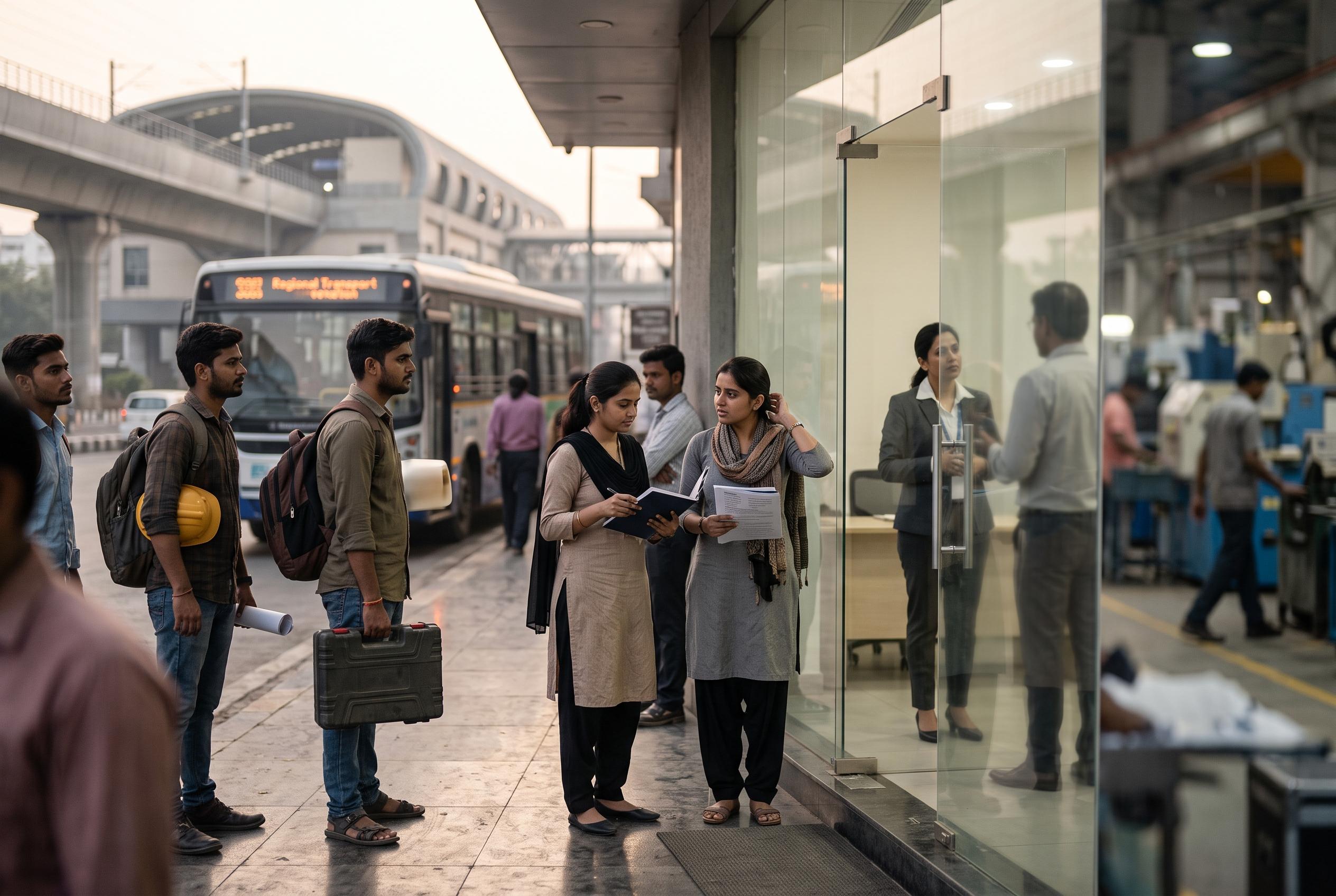

While India’s young workforce offers a vital economic advantage, rising unemployment, low female participation, and global economic uncertainties threaten to turn this demographic asset into a liability, prompting calls for urgent policy intervention.
India’s young workforce remains one of its biggest economic advantages, but the benefit will depend on whether the country can generate enough productive jobs to keep pace with growth. That is the central warning from CareEdge Ratings, which says the demographic dividend could become a liability if employment creation does not accelerate alongside the expansion of the labour force and output. The argument lands at a time when many major economies, including the US, the European Union and Japan, are ageing, giving India a rare window of opportunity that may not last indefinitely.
CareEdge’s review of International Labour Organisation modelled estimates suggests that India’s labour market has improved since the pandemic. Employment among people aged 15 and above rose by 3.5 per cent in 2021-25, well ahead of the 1.1 per cent pace seen in the previous five years, and far above the 0.5 per cent growth recorded in 2006-10. The same analysis says employment elasticity, a measure of how strongly jobs respond to economic growth, climbed to 0.46 in 2021-25 from 0.22 in 2011-15 and 0.08 in 2006-10. Still, the ILO has repeatedly warned that India’s long-run growth story has not translated into enough work opportunities for the working-age population, even as the quality of some jobs has improved.
The headline unemployment rate looks relatively contained. India’s Periodic Labour Force Survey put it at about 3.1 per cent from 2023 onwards, down from 6 per cent in 2018. But CareEdge cautions that the figure may understate joblessness in a country where self-employment is widespread, agriculture absorbs large amounts of labour with low productivity, and much work is seasonal, casual or irregular. The ILO has also noted in its India labour market assessments that regular employment has weakened over time and that economic expansion has often left too many workers outside stable, adequately paid jobs.
The bigger structural problem is participation. India’s labour force participation rate improved to 59.3 per cent in 2025 from 49.8 per cent in 2018, according to the analysis, but it still trails the global average of 61 per cent and remains below a number of Asian peers such as Vietnam, Singapore and Indonesia. The gap is driven largely by low female participation, which stands at around 32 per cent in India compared with 68 per cent in Vietnam and 59 per cent in China and Thailand. Youth unemployment is also elevated at 9.9 per cent, while higher educational attainment does not always translate into easier access to work, reflecting a persistent mismatch between skills and available jobs.
Employment patterns also underline how uneven India’s labour market remains. Agriculture still employs about 43 per cent of the workforce, even though it contributes only about one-fifth of gross value added, pointing to disguised unemployment and low productivity. Manufacturing, which played a decisive role in the rise of several East Asian economies, accounts for only 10-12 per cent of total employment, and the share of labour- and resource-intensive exports has slipped in recent years, according to the CareEdge review. Services have become the main engine of job creation, employing roughly 32 per cent of workers, with wholesale and retail trade, transport and storage, education, travel, hospitality and health care offering the clearest scope for further expansion.
The challenge is being sharpened by a global environment that is less supportive of hiring. The ILO’s May 2025 forecast cut its estimate for global job creation that year to 53 million from 60 million, citing a weaker growth outlook, geopolitical tensions and trade disruptions. At the same time, the spread of artificial intelligence and automation is changing how firms hire, including in India’s formal sector, where CareEdge says net employee additions across a sample of 236 Nifty 500 companies were flat in FY26 after stronger gains in FY22 and FY23. The weakest additions were in banking and financial services and in information technology, two sectors that had previously been seen as major employment engines.
That makes the policy response more urgent. CareEdge argues that India needs to create more productive jobs, move labour away from low-yield agriculture, and support labour-intensive manufacturing and services that can absorb workers at scale. It also says human capital investment must rise so that workers can match evolving demand, while social protection needs to be strengthened for the large informal workforce. The Code on Social Security, 2020 brought unorganised and gig workers into the wider framework, and official efforts have expanded pension, health and insurance coverage. But, as the ILO has said in its broader work on decent jobs and social justice, coverage alone will not be enough unless the jobs themselves are secure, better paid and more widely shared.
Disclaimer: This article is intended to inform and educate, not to recommend or endorse any financial product, investment or strategy. Please consider your own financial circumstances and seek professional advice where appropriate before making financial decisions.



