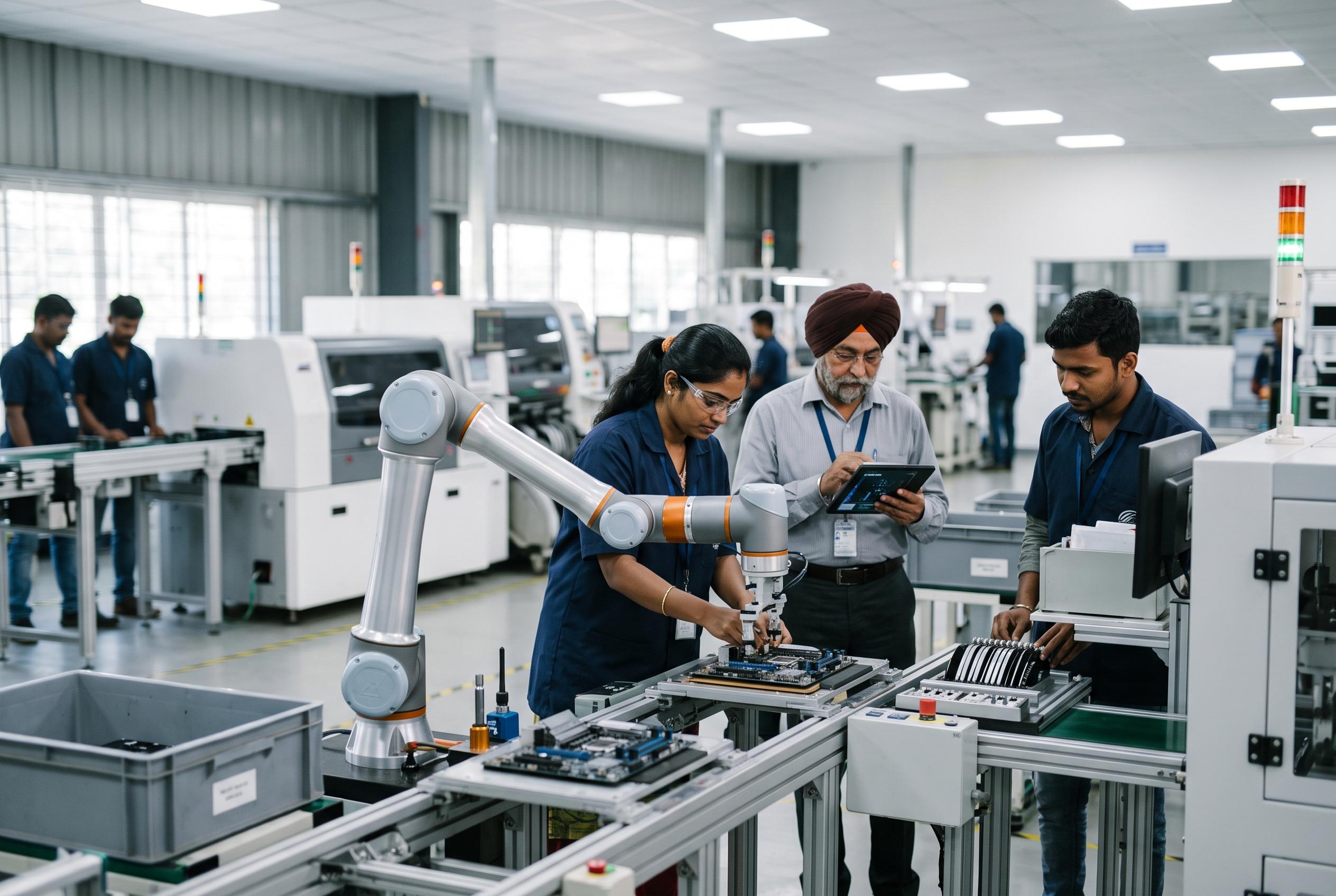

As robots and AI reshape India’s industries, the country’s policy needs to prioritise the type of capital that truly creates employment, shifting focus from aggregate investment to sectors and models that sustain jobs at scale.
India’s debate over jobs may be missing the larger point: the problem is not only how much capital the economy attracts, but what that capital is actually buying in an age of automation and artificial intelligence.
For years, policy assumed that investment and employment would move together. A new factory meant more output and, usually, more workers. That logic is weakening. As robots and AI take on tasks once reserved for people, capital can still lift production and profits without creating the same number of jobs. The shift is no longer confined to advanced economies; it is visible in India’s own manufacturing data and is beginning to reach services as well.
The pattern is clear in factory automation. Research cited in the article notes that India installed 9,100 industrial robots in 2024, making it one of the fastest-growing markets for industrial automation. That remains a small number beside China, which installed nearly 300,000 robots that year, but it shows how quickly Indian manufacturers are embracing machines that can replace or reduce labour rather than merely supplement it.
That same change is visible in India’s production-linked incentive programme. Government figures published this year show that the scheme has drawn more than ₹2.40 lakh crore in investment across 14 sectors and generated about 14.15 lakh direct and indirect jobs by March 2026. But the headline total conceals wide variation: labour-intensive areas such as food processing have produced far more employment per rupee than highly automated sectors such as electronics. In practice, the capital-to-job ratio depends heavily on how easily a business can be mechanised.
The article argues that policymakers should treat that distinction as central to industrial strategy. Instead of focusing only on aggregate investment, incentive design should favour sectors and business models that still absorb labour at scale. It also says India should build more of its AI capacity around small firms and micro-enterprises, where lower costs for sales, compliance and design could support new hiring rather than deeper concentration. Just as important, it argues that GDP alone is an incomplete guide, because output can rise even when employment weakens. Better measures would track new businesses, job creation, wage growth and survival rates at the district level.
That is the real policy shift India faces. Capital still matters, but in an economy shaped by robots and AI, the key question is no longer simply how much investment arrives. It is which kinds of investment still translate into work for people.
Disclaimer: This article is intended to inform and educate, not to recommend or endorse any financial product, investment or strategy. Please consider your own financial circumstances and seek professional advice where appropriate before making financial decisions.