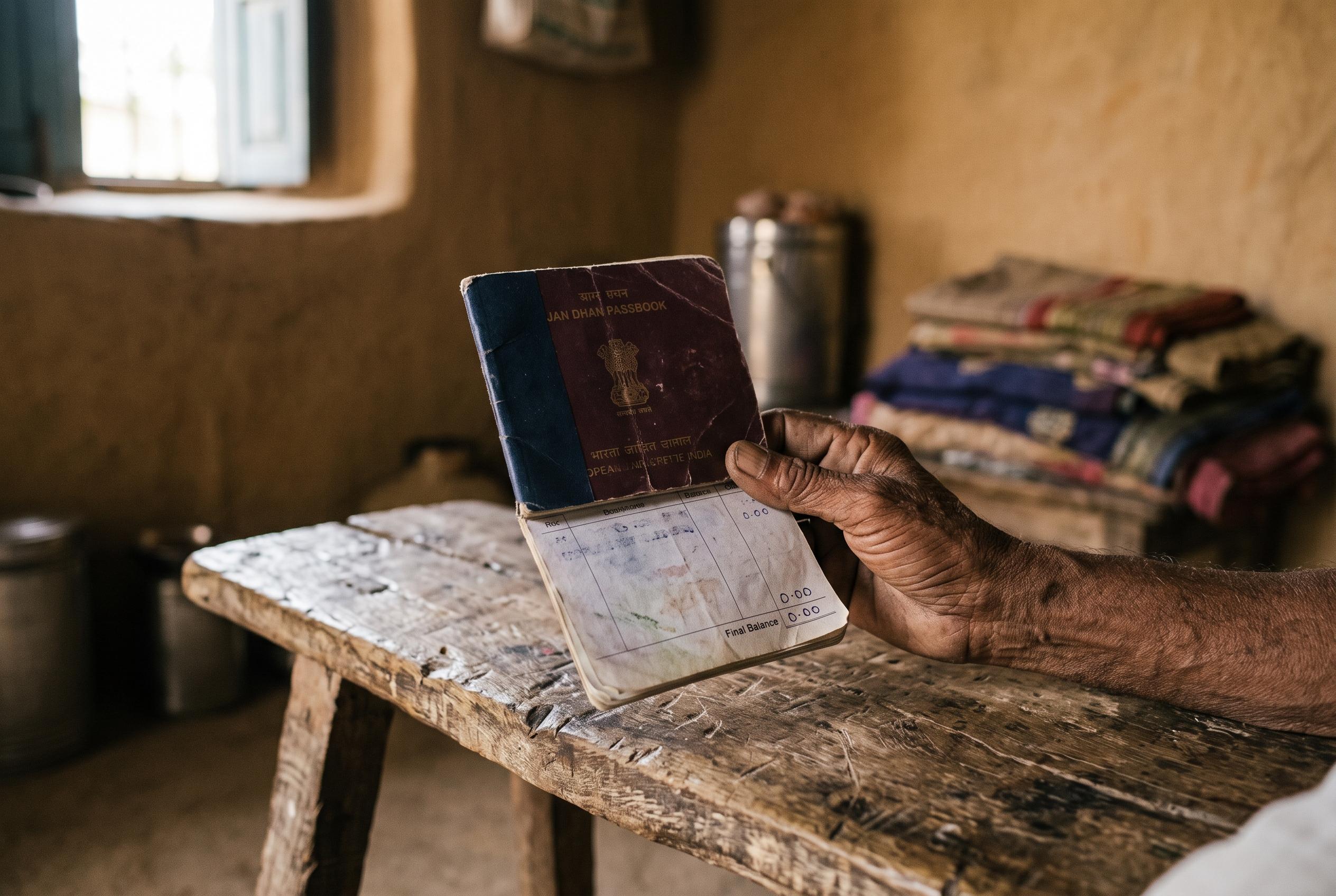

New RTI figures expose that over 15 crore Jan Dhan accounts in India remain inactive or have zero balance, raising questions about the scheme’s effectiveness in reaching the poorest.
India’s biggest financial inclusion scheme is still adding customers and deposits, but newly surfaced Right to Information data suggest that sheer scale masks a large pool of dormant use. The Finance Ministry’s own update for 19 August put Pradhan Mantri Jan Dhan Yojana at 59.09 crore accounts with deposits of Rs 3,16,514 crore. Yet an RTI-based snapshot taken a week earlier, on 12 August, showed 15,36,77,009 accounts classed as inoperative and 5,72,35,490 carrying a zero balance. (m.economictimes.com)
The RTI reply, dated 1 September and sent by the Department of Financial Services to activist Chandra Shekhar Gaur, put the national total at 59,03,74,907 PMJDY accounts holding Rs 3,15,179.90 crore. Reports first carried from Jaipur on 3 September and then more widely on 6 September showed that the official tally was still inching upwards later in the month, even as the stock of inactive and empty accounts remained strikingly large. (m.economictimes.com)
The figures also expose how much the Centre does not publish in usable detail. While the RTI reply said 32.89 crore accounts were held by women, including transgender account holders, and 26.14 crore by men, it also said the government does not centrally maintain a gender-wise break-up of balances, zero-balance accounts or inoperative accounts. Nor does it centrally track accounts with less than Rs 100 in them, accounts shut over the past five years, or accounts blocked or frozen because of suspicious transactions or cyber fraud. (dailyexcelsior.com)
The state pattern shows the problem is concentrated where the scheme is biggest. Uttar Pradesh led on every major count: 10.51 crore total accounts, 95.92 lakh zero-balance accounts and 3.23 crore inoperative ones. Bihar followed with 7.01 crore accounts overall, including 62.35 lakh with no balance and 1.59 crore marked inoperative. West Bengal, Maharashtra and Rajasthan were also among the largest states by total accounts, while Assam featured prominently in the zero-balance list and Madhya Pradesh in the inoperative ranking. (m.economictimes.com)
Where these accounts sit is less straightforward. Kisan India reported that 67 per cent of PMJDY accounts were in rural and semi-urban areas, using that distribution to argue that inactivity is likely to be concentrated away from big cities. However, the Finance Ministry’s anniversary release later in August put the rural and semi-urban share significantly higher, at 77.8 per cent, equal to 45.95 crore accounts as of 19 August. That same release put women at 55.7 per cent of account holders. (kisanindia.in)
The broader policy story is that PMJDY has changed purpose as it has grown. Launched on 28 August 2014 as the National Mission for Financial Inclusion, it began as a push to bring households into the banking system. According to the Department of Financial Services’ annual report, the scheme was later extended beyond August 2018 and refocused on reaching every unbanked adult. The official pitch remains expansive: no minimum balance requirement, no maintenance charges, a RuPay debit card with accident cover of up to Rs 2 lakh, and an overdraft facility of up to Rs 10,000. (pib.gov.in)
Ministers still present that expansion as a structural change in how welfare reaches poorer Indians. In the 27 August release marking the scheme’s 12th anniversary, minister of state for finance Pankaj Chaudhary said PMJDY should not be viewed only through account-opening numbers, but through service delivery to “the poorest of the poor” without “the involvement of middlemen”. The ministry said deposits under the scheme had risen 12.8 times and account numbers 2.3 times since August 2015; average deposits stood at Rs 5,356 on 19 August, and 41.29 crore RuPay cards had been issued. (pib.gov.in)
The RTI disclosure does not disprove that official success story, but it does put a hard number on its weakest point: opening an account is not the same as keeping it in use. A scheme that can claim more than 59 crore accounts and more than Rs 3.16 lakh crore in deposits is plainly vast. It is also, by the government’s own RTI response, still carrying more than 15 crore inoperative accounts, while the public dashboard remains far more forthcoming on growth than on dormancy. (m.economictimes.com)
Disclaimer: This article is intended to inform and educate, not to recommend or endorse any financial product, investment or strategy. Please consider your own financial circumstances and seek professional advice where appropriate before making financial decisions.