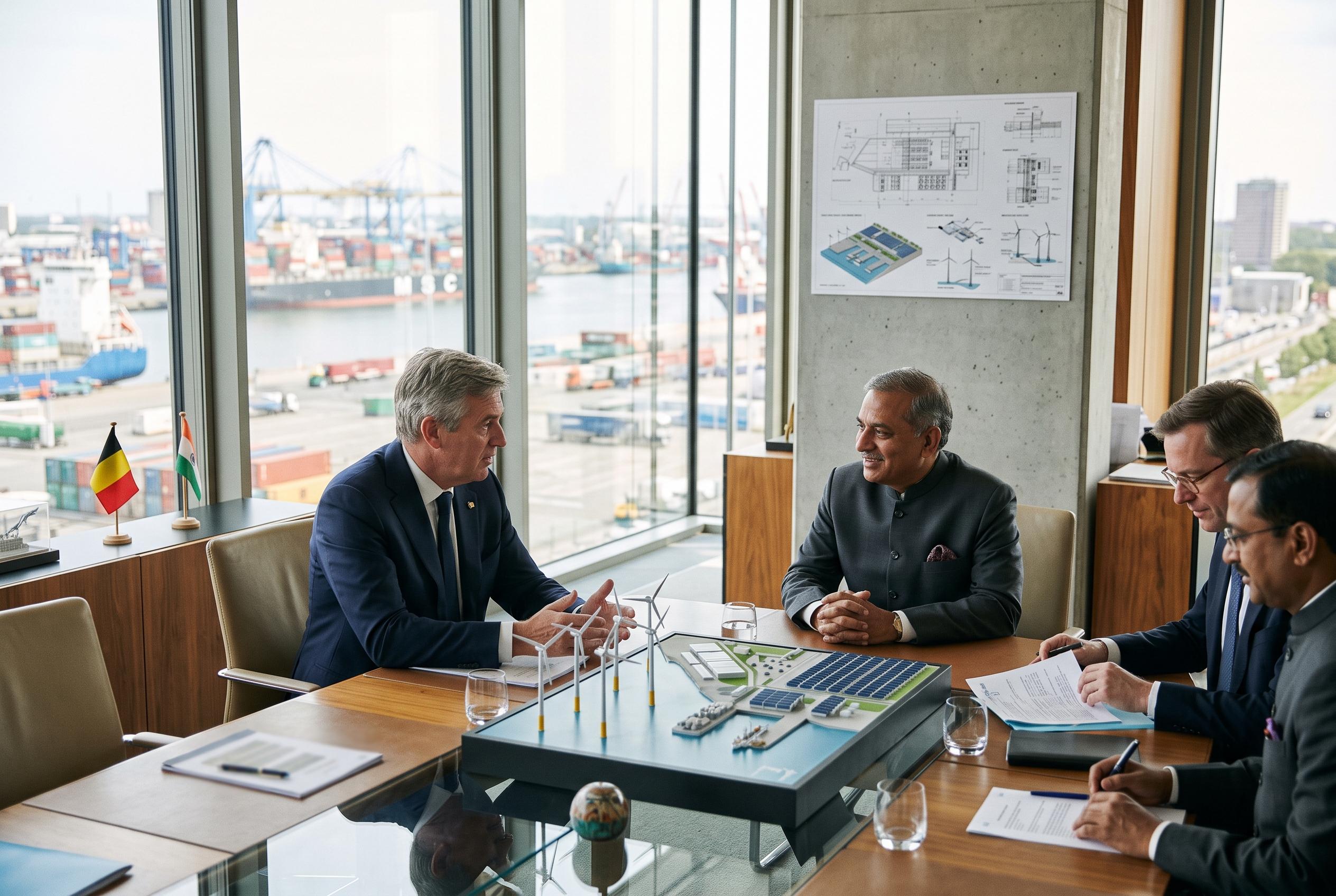

Belgium’s Prime Minister de Wever’s visit to India signals a strategic push to double bilateral trade, expand port cooperation, and integrate defence and clean energy initiatives, with upcoming high-level delegations set to boost cross-continental collaboration.
Belgium has fixed a return trip to India for 1 to 5 February 2027 with companies from the Port of Antwerp-Bruges and the wider port community, turning this week’s diplomacy into a timetable for follow-up business. The pledge came as New Delhi and Brussels set themselves the far larger goal of doubling bilateral trade within five years from the $10.92 billion recorded in 2025-26, with both sides trying to convert the recently concluded India-EU free trade agreement into new cargo flows, investment and industrial projects.
The visit by Belgian Prime Minister Bart De Wever, which ran from 2 to 4 September, was presented in Indian reports as the first by a Belgian premier in two decades and produced a noticeably broader agenda than ports alone. Alongside trade and clean energy, Narendra Modi and De Wever agreed to deepen work on defence, advanced technology and law enforcement, while their discussions ranged across semiconductors, chemicals, pharmaceuticals, fintech, advanced manufacturing, logistics and clean energy. Hindustan Times reported that defence companies also concluded co-production agreements covering a range of military equipment.
That widening agenda matters because the trade pact is being treated by both governments as more than a tariff-cutting exercise. The Port of Antwerp-Bruges said EU goods exports to India were worth nearly €49 billion in 2024 and could double by 2032, citing European Commission estimates. The port is trying to place itself at the centre of that expansion: it handled 6.3 million tonnes of Indian trade in 2025, making India its third-largest partner for breakbulk and seventh for containers, and it has maintained a permanent presence in Mumbai since 2006. Its message, in effect, is that the agreement will only change commerce if shipping, warehousing, customs and inland transport are lined up behind it.
Modi used the meeting in New Delhi to point to existing projects that show the relationship is already moving beyond speeches. According to Mint, he cited work on the Zorawar tank and on a major green ammonia facility in Kakinada, Andhra Pradesh, as examples of the two countries’ expanding partnership in defence and clean energy. The same report said Modi reminded De Wever of an older connection too, recalling his support for the diamond trade and the Indian community while serving as mayor of Antwerp, a reminder that the commercial bond predates the current push on strategic industries.
Mumbai then became the stage for a more specific sales pitch. Speaking there, Maharashtra Chief Minister Devendra Fadnavis proposed a Mumbai-Antwerp Economic Partnership spanning ports, logistics, technology and clean energy. He said Maharashtra accounts for about 15 per cent of India’s GDP and exports, attracts nearly one-third of foreign direct investment coming into the country and holds roughly 66 per cent of India’s data-centre capacity. Calling the state and Belgium complementary partners, he invited Belgian businesses to back Maharashtra’s aim of becoming a $1 trillion economy by 2030, with cooperation focused on advanced manufacturing, semiconductors, clean energy, pharmaceuticals and biotechnology, and ports and logistics.
Fadnavis also tried to attach the Belgium talks to concrete infrastructure in western India. He said Jawaharlal Nehru Port, the planned Vadhavan deep-sea port, Navi Mumbai International Airport and surrounding multimodal links could make Maharashtra a bigger logistics hub for Europe-bound trade. Free Press Journal reported that he urged closer work with Antwerp-Bruges on digitalisation, green shipping, hydrogen, logistics and skills, while Akashvani said he proposed a joint team to identify a shortlist of projects and fast-track them. That suggestion gives the state-level side of the visit a practical mechanism that mirrors the new India-Belgium investment fast-track arrangement announced at the national level.
Belgium, for its part, used the visit to underline that supply chains and security now sit alongside pure trade promotion. De Wever said Belgium would send a full delegation from the maritime and port sector to India in February next year, with Akashvani describing the mission as a step towards “concrete work” in maritime cooperation. NDTV Profit reported that the two sides also discussed direct air connectivity, pharmaceutical air cargo and advanced air mobility, while Belgium’s dredging expertise was highlighted as another possible area for collaboration in port development and related infrastructure.
De Wever’s language suggested he sees India less as a single bilateral relationship than as part of Europe’s answer to a rougher trading environment. “We are sailing through rough waters, but pressure creates diamonds. India and the EU have decided to do that,” he said, according to NDTV Profit. In Mumbai, he argued that the trade agreement could help connect a market of roughly two billion consumers and create room for more investment, research, innovation and jobs. Indian ministers struck a similar note: Akashvani quoted Piyush Goyal as saying that in a more uncertain world there were “only two choices – to be swept away by the prevailing instability or to build bridges of trust”. The substance of this visit suggests India and Belgium want the second option to run through ports, factories, laboratories and defence workshops, not just through diplomatic communiqués.
Disclaimer: This article is intended to inform and educate, not to recommend or endorse any financial product, investment or strategy. Please consider your own financial circumstances and seek professional advice where appropriate before making financial decisions.