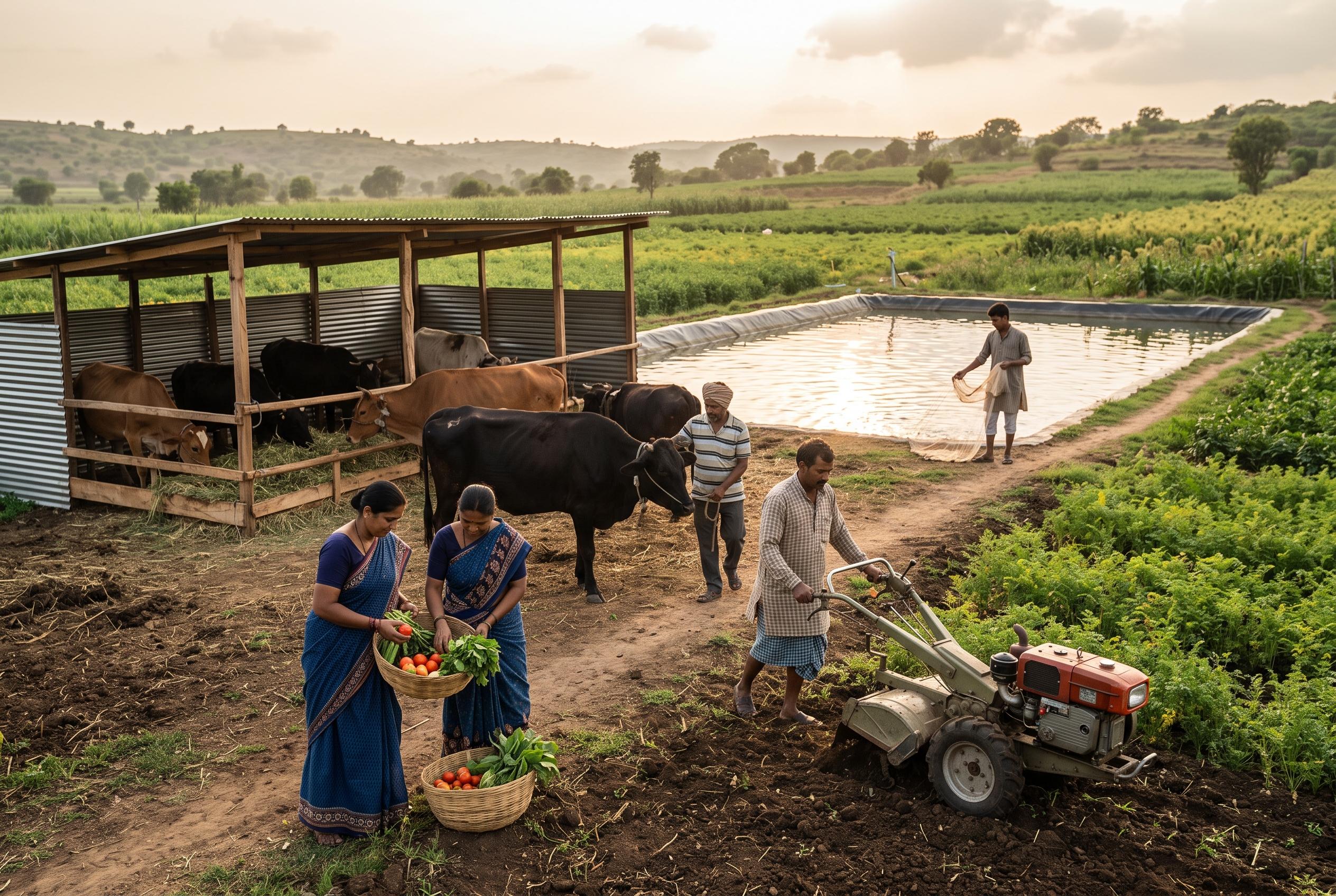

India’s agricultural sector is shifting focus beyond crops, with livestock, fisheries, and allied activities increasingly contributing to rural incomes and employment, highlighting both potential and integration challenges within modern supply chains.
India’s farm economy is moving steadily beyond crops, with livestock, fisheries, aquaculture and other allied activities taking a larger share of output and rural livelihoods. Government data cited by NDTV Profit shows that agriculture and allied sectors accounted for 18.2% of gross value added at current prices in 2022-23, even though crops still make up more than half of agricultural output. That shift reflects a broader diversification of the countryside, where growth is increasingly being driven by activities that are less dependent on a single harvest cycle and more closely tied to changing diets, incomes and market demand.
Several forces lie behind this rise. As consumption patterns change, demand for milk, meat, eggs, fish and processed foods has expanded, giving farmers more room to earn from activities that can generate cash more regularly than seasonal cropping. Allied activities also suit small and marginal farmers, who can raise a few animals, rear poultry or take up fisheries alongside farming on limited land. Policy Edge notes that states with faster growth in agriculture and allied activities have also tended to grow faster overall, suggesting that these sectors are becoming central to rural dynamism rather than merely supplementary.
Their contribution to income and employment is substantial. A study in Think India Quarterly notes that agriculture still provides direct employment to more than half of India’s workforce, even as its share in GDP has declined. Within that broad base, allied activities are especially valuable because they spread income through the year, reduce dependence on one crop, and create work in feeding, care, transport, processing and marketing. They also support women’s participation, particularly in dairying, poultry and value addition, where labour demands are frequent and household-based. For landless and near-landless households, these activities often provide a crucial bridge between subsistence and stable earnings.
Yet these sectors remain poorly connected to efficient value chains. Production is fragmented, with many small producers lacking the scale to bargain, aggregate supply or meet uniform quality standards. Storage, cold chains and processing facilities remain weak, which raises wastage and limits the sale of perishables. Credit is another bottleneck: Business Standard reported that while farm credit has grown strongly in recent years, the share reaching allied activities remains small. Animal-health services, veterinary infrastructure, insurance coverage, traceability and market information are also uneven, making it harder for producers to link with organised buyers. The result is a sector with strong growth potential but limited integration into modern supply chains. The policy answer lies in producer-owned and technology-enabled systems built around aggregation, processing, cold logistics, reliable veterinary support and easier finance.
Disclaimer: This article is intended to inform and educate, not to recommend or endorse any financial product, investment or strategy. Please consider your own financial circumstances and seek professional advice where appropriate before making financial decisions.