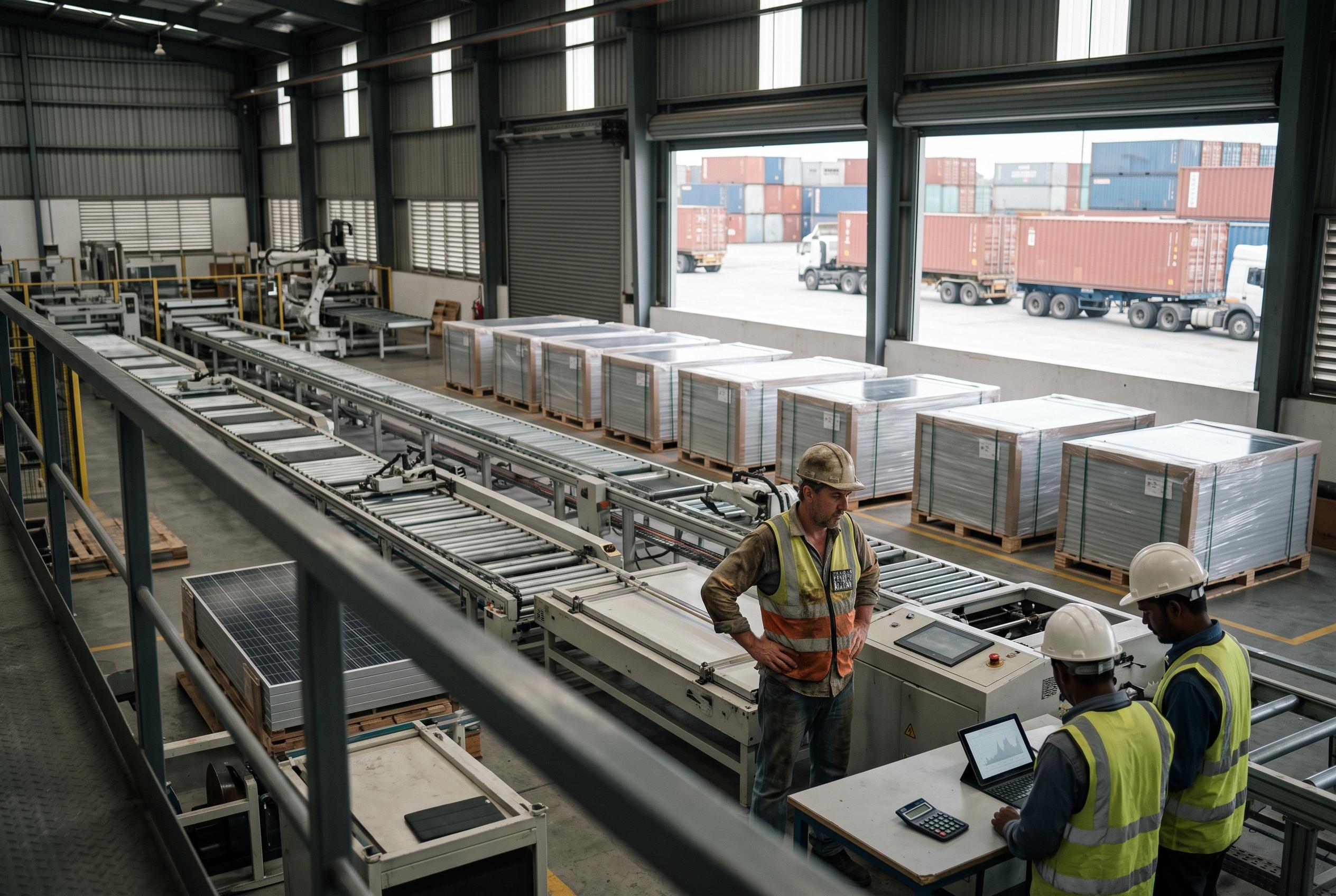

India’s rapid expansion in solar module manufacturing has outpaced domestic demand and supply chain development, raising concerns over factory utilisation, export dependence, and industry sustainability, according to a new report.
India’s solar manufacturing boom is running far ahead of the market it is meant to serve, raising questions about whether the country can turn rapid expansion into a durable industrial base. A new report from the Institute for Energy Economics and Financial Analysis and JMK Research says module manufacturing capacity had reached about 233GW by June 2026, making India one of the world’s largest solar panel hubs, but the build-out is still heavily skewed towards the final stage of production rather than the materials and components that sit upstream.
That imbalance is stark. According to the report, module capacity is now almost seven times cell capacity and 116 times ingot-wafer capacity, leaving cells, wafers and polysilicon underdeveloped and the supply chain dependent on imported inputs, largely from China. Factory utilisation is estimated at only 35% to 40%, well below the 50% to 65% level generally viewed as sustainable, and around 135GW of additional capacity is already planned or under construction. Prabhakar Sharma, senior consultant at JMK Research, warned that standalone module makers face a real risk of stranded assets if supply keeps rising faster than demand.
The report argues that the pressure is unlikely to ease by 2030. India’s solar deployment is expected to keep growing, but not quickly enough to absorb all the manufacturing capacity already committed. New sources of demand, including data centres, green hydrogen, green ammonia and exports, could add an incremental 17GW to 22GW by the end of the decade, with green hydrogen offering the biggest single opportunity because of the dedicated renewable power it requires. Even so, that is unlikely to fully bridge the gap.
Exports may therefore become decisive, but that route is becoming more complicated. The report says the US took about 97% of India’s module export volume in financial year 2026, only for that market to be hit by combined duties of more than 200% on most Indian manufacturers. That has already cut exports to the US by 44% to 47% from their FY2024 peak. The European Union, with its more explicit focus on supply-chain diversification, is seen as the most credible medium-term alternative. Charith Konda, lead energy specialist at IEEFA, said Indian manufacturers will need to invest in research and development and move deeper into polysilicon, ingots, wafers and cells if they want to compete with Chinese rivals.
The report also suggests the shake-out may reshape the industry itself. Smaller, non-integrated manufacturers are likely to come under the most strain, while larger, vertically integrated groups should be better placed to survive. It calls for incentives to be spread more evenly across the value chain, faster transmission build-out and quicker right-of-way clearances to support domestic deployment, plus a framework for repowering older solar assets. Chirag H. Tewani, senior research associate at JMK Research, said the challenge is no longer simply building capacity but using it well and deepening the value chain.
Disclaimer: This article is intended to inform and educate, not to recommend or endorse any financial product, investment or strategy. Please consider your own financial circumstances and seek professional advice where appropriate before making financial decisions.