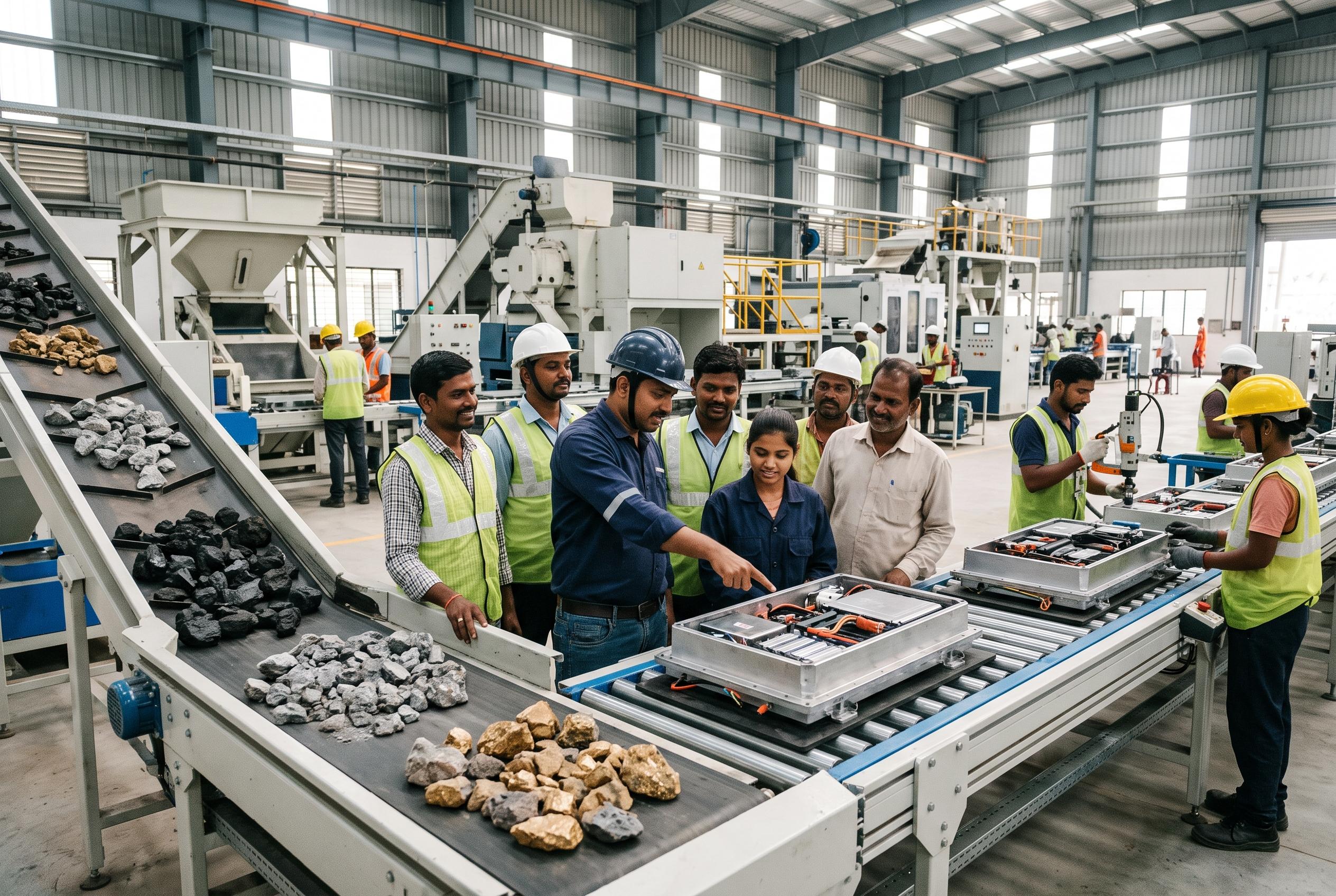

Andhra Pradesh is shifting from mineral extraction to a value-added model by promoting local processing and manufacturing, aiming to create jobs and maximise state revenue from mineral resources such as gold, coal, titanium, lithium, and steel investments.
Andhra Pradesh is trying to turn mineral endowment into industrial depth, betting that the real value lies not only in what is dug up, but in what is made afterwards. State officials are promoting a minerals-to-manufacturing strategy that would keep more processing, refining and production inside Andhra Pradesh, rather than sending raw material out of the state and capturing only a small share of the final value.
The clearest early example is gold. According to The Hindu, Geomysore Services India Pvt Ltd has begun producing gold bars from the Swarnagiri mine near Jonnagiri in Kurnool district, marking a shift from extraction to local bullion manufacture. Government officials say production started in July and is expected to reach about 1,000 kg a year, with room to expand. The company is marketing 50-gram to 500-gram bars branded as made in Andhra and made in Jonnagiri, a sign that the state wants to build an identity around processed minerals, not just ore.
Officials are now looking at whether that model can be widened. Mukesh Kumar Meena, the principal secretary for revenue and mines, told The Hindu that the state plans to auction several other gold-bearing belts, including Boksampalli, Javakula, Chigurugunta and Ramagiri, where yields are expected to be higher. The broader aim is to encourage nearby ornament-making and bullion clusters, so that mining, refining, manufacturing and sales can develop as a single local chain. That could create jobs, support smaller suppliers and lift revenues from royalties and goods and services tax.
The same thinking is being applied to coal. The Hindu reported that Reliance Industries has proposed a coal-gasification project near Recherla and Chintalapudi in Eluru district, with investment of more than ₹2 lakh crore. If it goes ahead, the underground project could convert coal into syngas and then into hydrogen, ammonia, urea, methanol and synthetic natural gas, opening the door to a much wider industrial base. Meena said the project would operate deep underground and could support thousands of jobs through ancillary industries.
Other mineral-linked projects are also gathering pace. Adani Group has proposed a ₹16,000 crore beach-sand project in Srikakulam to extract titanium and make higher-value products, while preliminary work by the National Geophysical Research Institute has pointed to traces of lithium and gallium in Tummalapalle in Kadapa district. Andhra Pradesh has signed an agreement with NGRI and IIT Dhanbad to explore those critical minerals for use in batteries, semiconductors and satellite components. At the same time, large steel investments are under way, including ArcelorMittal Nippon Steel India’s plant near Anakapalli and JSW Steel’s project in Kadapa, which together could further anchor the state’s push to become a manufacturing hub.
Disclaimer: This article is intended to inform and educate, not to recommend or endorse any financial product, investment or strategy. Please consider your own financial circumstances and seek professional advice where appropriate before making financial decisions.