

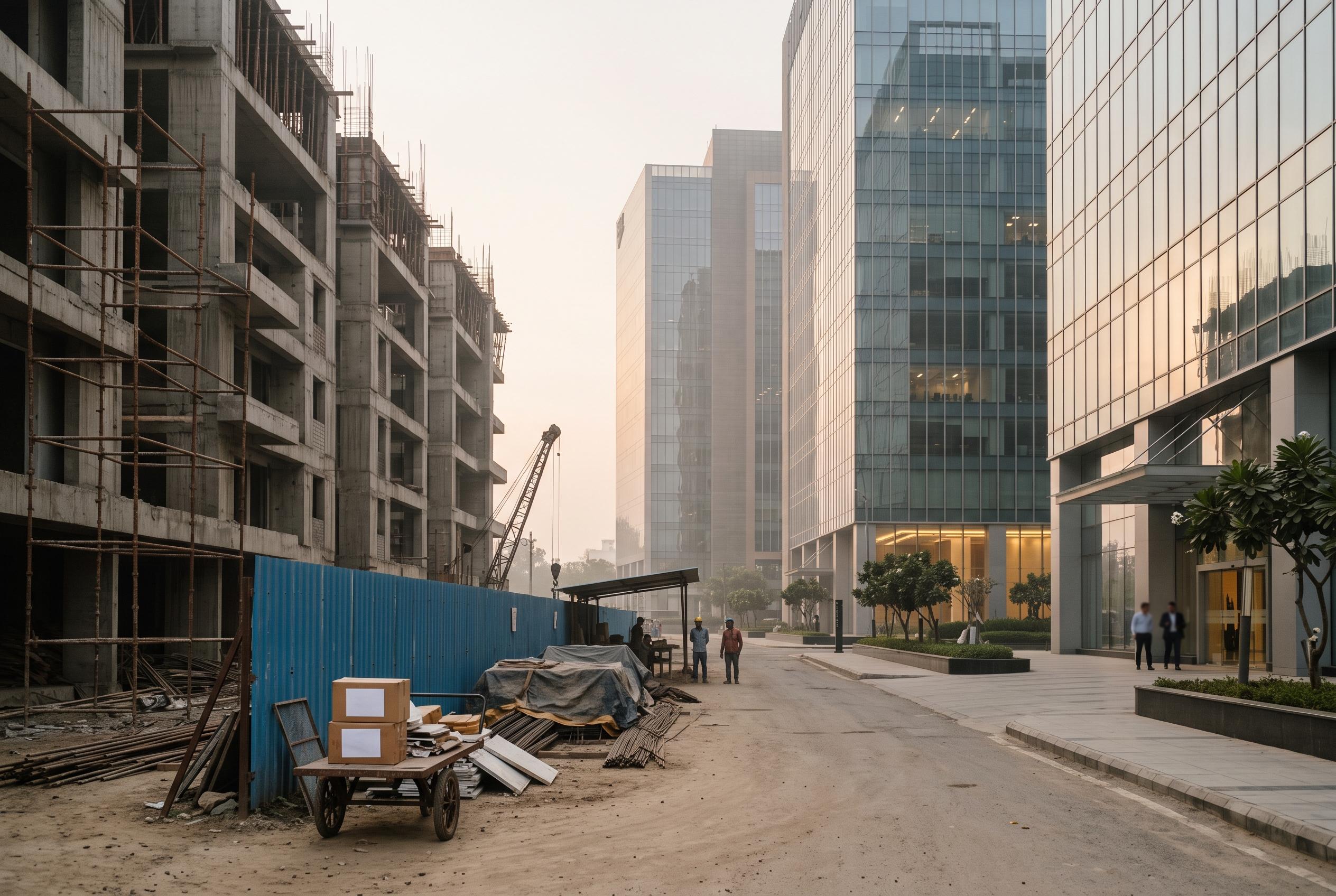

While office leasing and REITs in India hit new highs driven by global companies and environmentally certified spaces, the housing sector faces delays and a slowdown in pre-sales, highlighting a widening divide in the country’s property market.
India’s real estate market is increasingly split in two. Commercial property continues to attract strong demand, while listed housing developers are feeling the strain of slower pre-sales and delayed launches. In a report highlighted by NDTV Profit, Equirus Capital said gross office leasing across the top cities hit a record 24.6 million square feet in the June quarter, helping first-half absorption reach an all-time high. That momentum has also lifted real estate investment trusts, which are benefiting from rising rents, tighter supply and a larger pool of developer-held assets available for acquisition.
The office story is being driven largely by Global Capability Centres, the offshore technology, engineering and support hubs run by multinational companies in India. Equirus said they accounted for a record share of leasing in the first half of 2026, with Bengaluru leading the pack. Other market trackers have reached broadly similar conclusions: Cushman & Wakefield said gross leasing in the first half of 2026 was about 43 million square feet and that GCCs made up 38% of activity, while vacancy fell to a post-pandemic low. Business Standard, citing Knight Frank, reported first-half office leasing of 48 million square feet, underscoring how firm demand remains even as different firms use slightly different counting methods.
REITs have scaled up alongside that demand. Equirus said their share of India’s organised office stock has risen sharply in recent years, while market value and the number of unitholders have also expanded quickly. LiveMint reported that the six listed REITs are now pushing further into acquisitions and development to capture the demand for premium office space. Business Standard also noted that green leasing, or demand for environmentally certified offices, has become a bigger feature of the market, adding another layer to the commercial upcycle.
Housing, by contrast, is moving more unevenly. NDTV Profit said listed developers posted a steep drop in quarterly pre-sales, with DLF and Prestige Estates weighing on the total. Equirus Securities linked the weaker launch pipeline more to approvals and timing than to a collapse in demand, and said collection efficiency improved as builders converted more previously sold inventory into cash. That said, not every external gauge shows the same weakness: Business Standard reported that residential sales across India were still holding up well in the first half of 2026, suggesting the market is stabilising rather than turning decisively down. The broader picture is one of divergence, with offices and REITs continuing to compound while housing developers wait for the supply side to catch up.
Disclaimer: This article is intended to inform and educate, not to recommend or endorse any financial product, investment or strategy. Please consider your own financial circumstances and seek professional advice where appropriate before making financial decisions.



