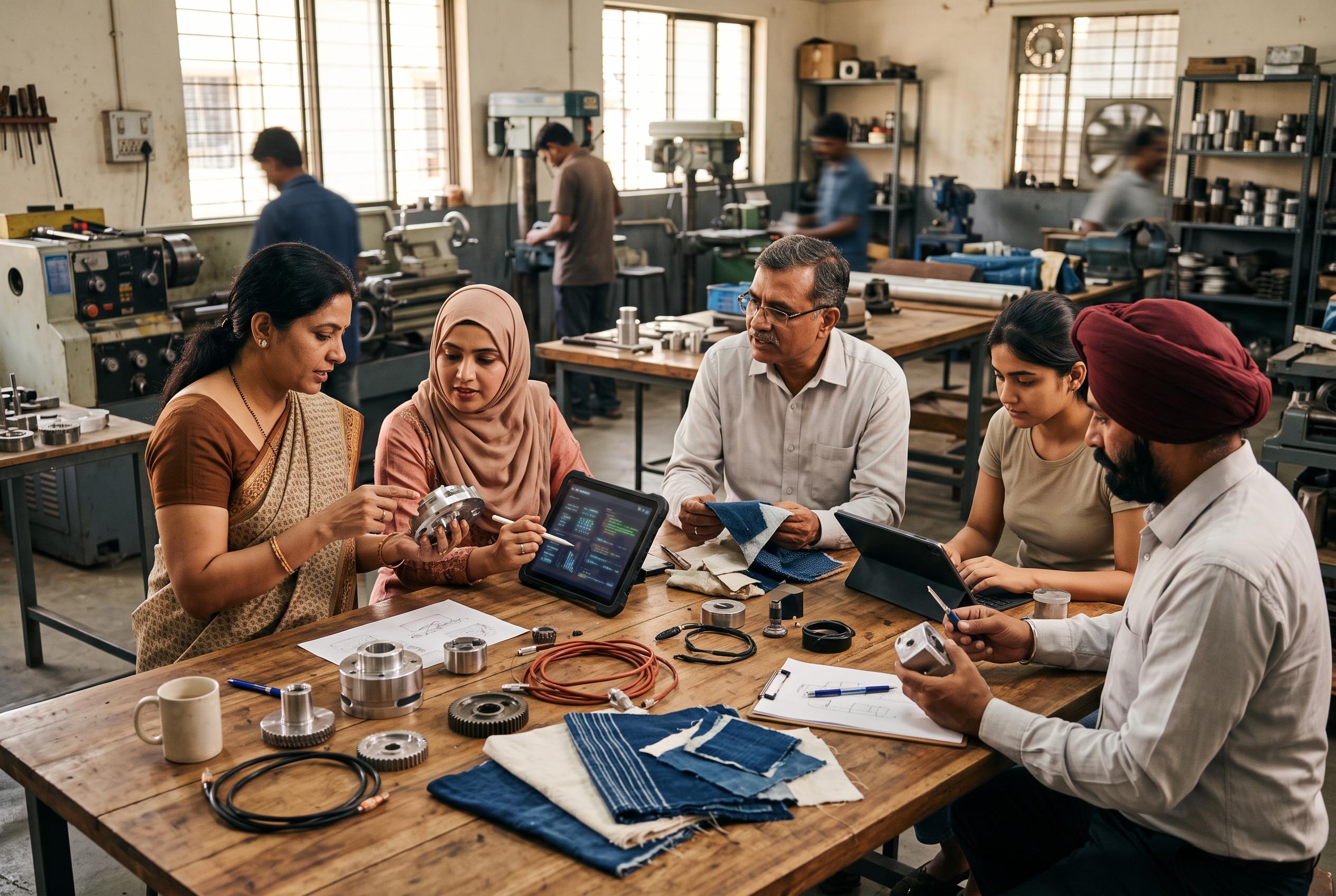

India’s MSME sector has entered a new phase of policy attention with amendments aimed at widening formal registration, easing finance and expediting payment disputes, strengthening its role in growth, jobs, and exports.
India’s Micro, Small and Medium Enterprises sector has entered a new phase of policy attention as Parliament approves amendments aimed at widening formal registration, easing finance and speeding payment disputes. In an opinion piece, the Minister of State for MSME and Labour and Employment said the changes are intended to strengthen a sector that the government sees as central to growth, jobs and exports.
The case for reform rests in part on the scale of the sector itself. According to the minister, more than 9 crore MSMEs are now registered on the Udyam portal, up sharply from 1.65 crore on 1 April 2023. Independent reporting has also pointed to the sector’s broad economic footprint, with Nation Press saying MSMEs contribute about 31.1% of GDP and employ roughly 38.9 crore people, while also accounting for nearly half of exports. IBEF has likewise described the sector as a major pillar of manufacturing and services output, with more than 7.9 crore enterprises registered across Udyam-related platforms by March 2026.
A key change in the policy framework came in 2020, when the government removed the old split between manufacturing and services for classification purposes and adopted a combined test based on investment and turnover. That was expanded in 2025, when the limits were raised to allow firms to grow further before losing MSME status. The minister said the higher thresholds have encouraged businesses to invest more, modernise operations and adopt technology.
Access to credit remains the most important constraint for many smaller firms, and the government says this is where recent gains have been most visible. The minister said outstanding credit to MSMEs has risen from ₹10 lakh crore in 2014-15 to more than ₹38.35 lakh crore. Credit support through the Credit Guarantee Trust for Micro and Small Enterprises has also expanded sharply, while the Prime Minister’s Employment Generation Programme has provided margin money subsidies to lakhs of micro enterprises and helped generate employment at the grassroots level.
Payment delays continue to be another structural problem, and the reforms seek to tackle that as well. The Trade Receivables Discounting System, a Reserve Bank of India-regulated digital platform launched in 2017, has become an increasingly important channel for invoice discounting. The minister said payments routed through TReDS reached ₹8.71 lakh crore by March 2026, with the number of participating MSMEs and the volume of discounted invoices both rising sharply.
The amendment also seeks to strengthen the dispute-resolution system around delayed payments. India already has 161 Micro and Small Enterprises Facilitation Councils, but the new law gives states more flexibility over their composition and supports the creation of additional councils. It also gives a clearer role to online dispute resolution, sets time limits for faster settlement and allows recovery of mediated settlements or arbitral awards as arrears of land revenue. In addition, it decriminalises certain offences and replaces conviction-based penalties in some cases with graded sanctions, including warnings for first-time breaches.
The government is also highlighting the sector’s role in widening participation by women and disadvantaged communities. The minister said women own more than 39% of MSMEs on Udyam, while more than 1.24 crore MSMEs are owned by entrepreneurs from Scheduled Caste and Scheduled Tribe communities. Special credit guarantees, procurement support and subsidies are being used to encourage their participation, alongside the National SC-ST Hub scheme, which aims to deepen entrepreneurship in those communities.
Taken together, the measures show a shift towards a more formal, digitally connected MSME ecosystem, one that is meant to grow without being held back by delayed payments, access barriers or compliance friction. The government argues the package supports its broader ambition of a more inclusive and employment-oriented economy under the Viksit Bharat 2047 vision. For millions of small firms, the test will be whether the new rules translate into easier borrowing, faster cash flow and a less burdensome path to expansion.
Disclaimer: This article is intended to inform and educate, not to recommend or endorse any financial product, investment or strategy. Please consider your own financial circumstances and seek professional advice where appropriate before making financial decisions.