

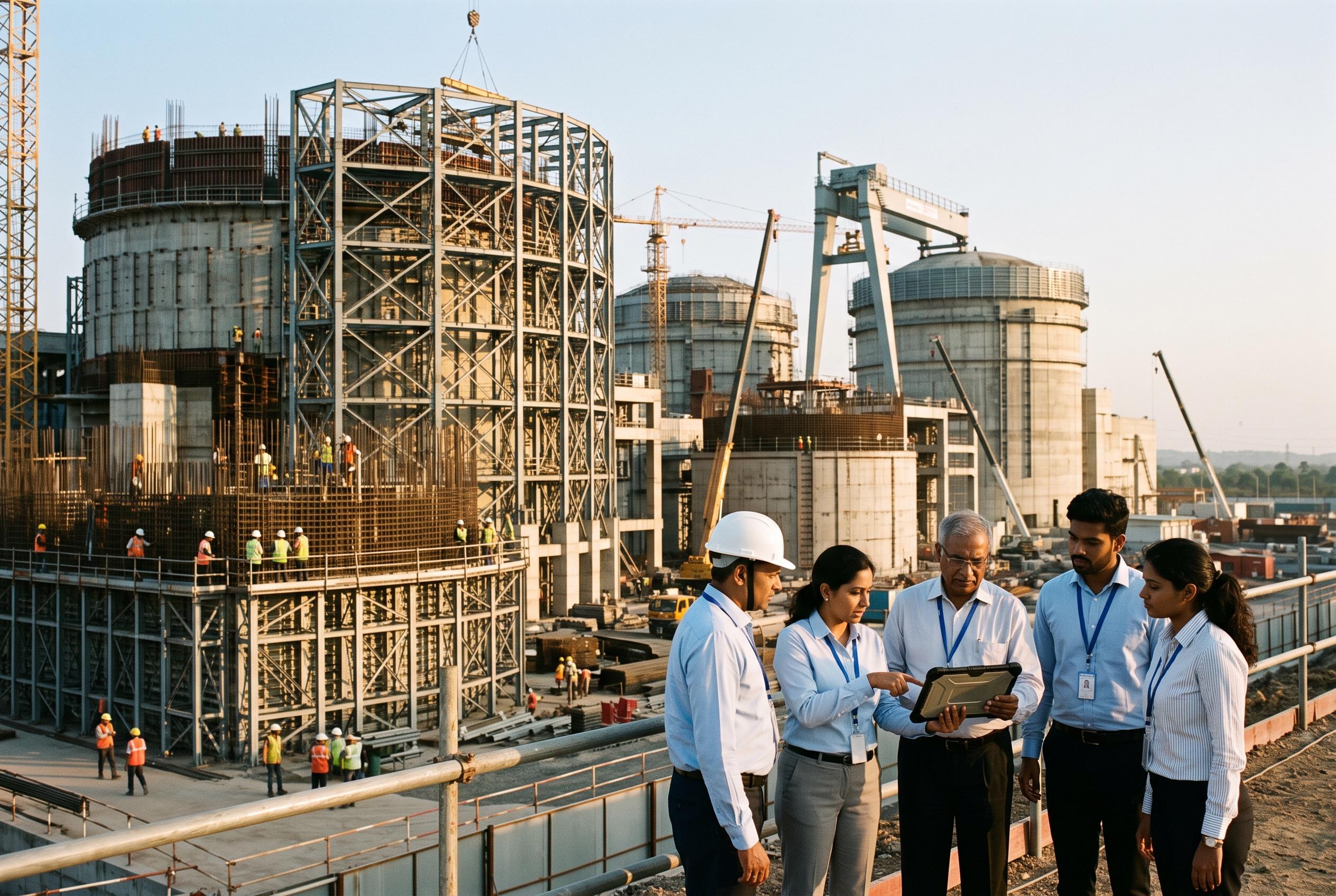

India’s leading power companies are favouring indigenous nuclear reactor designs to speed up project timelines and reduce costs, marking a significant shift in the country’s nuclear strategy as private sector participation increases.
India’s biggest power groups are turning to home-grown nuclear reactor designs as they try to move faster in a sector long dogged by delays and rising costs. Adani Group, Jindal Steel and state-owned NTPC are all leaning first on Indian pressurised heavy water reactors, a technology they say should shorten approvals and ease procurement because the supply chain is already in place.
At a BloombergNEF conference in New Delhi, Vivek Sharma, business head at Adani Atomic Energy, said India already has a standard 700 megawatt design that is operating domestically. That matters because nuclear projects often lose time in permitting, engineering changes and equipment sourcing, all of which can inflate the final bill and threaten the economics of a plant.
The shift also reflects a broader policy change. The government opened the strategically sensitive nuclear sector to private firms last year as part of a plan to raise atomic capacity to 100 gigawatts by 2047, up from a sector that currently provides about 3% of India’s electricity. Earlier this month, the Department of Atomic Energy issued draft rules for private companies to build plants, ending the state monopoly held for decades by Nuclear Power Corp., which runs India’s 8.8 gigawatts of atomic capacity.
Jindal Steel’s Naveen Ahlawat told the summit that construction delays quickly become cost overruns and can make power too expensive to compete. He said the company’s first two reactors would most likely use the 700 megawatt domestic design, though it is also looking at options from Russia’s Rosatom and France’s EDF. NTPC, meanwhile, sees locally designed reactors as its most practical starting point as it targets 30 gigawatts of nuclear capacity by 2047 to help reduce dependence on coal. The company’s first project with Nuclear Power Corp. will use four indigenous units, and NTPC director of projects K. Shanmugha Sundaram said most of its planned capacity would rely on large pressurised water and heavy water reactors because Indian heavy water technology is currently the cheapest option.
Prime Minister Narendra Modi said in his Independence Day speech on August 15 that India aims to start five reactors within six to seven years. Billionaire Gautam Adani has already announced plans for 10 gigawatts of nuclear capacity, while Mukesh Ambani’s Reliance Industries has signed a preliminary agreement to invest 2 trillion rupees in atomic projects in Maharashtra.
Disclaimer: This article is intended to inform and educate, not to recommend or endorse any financial product, investment or strategy. Please consider your own financial circumstances and seek professional advice where appropriate before making financial decisions.



