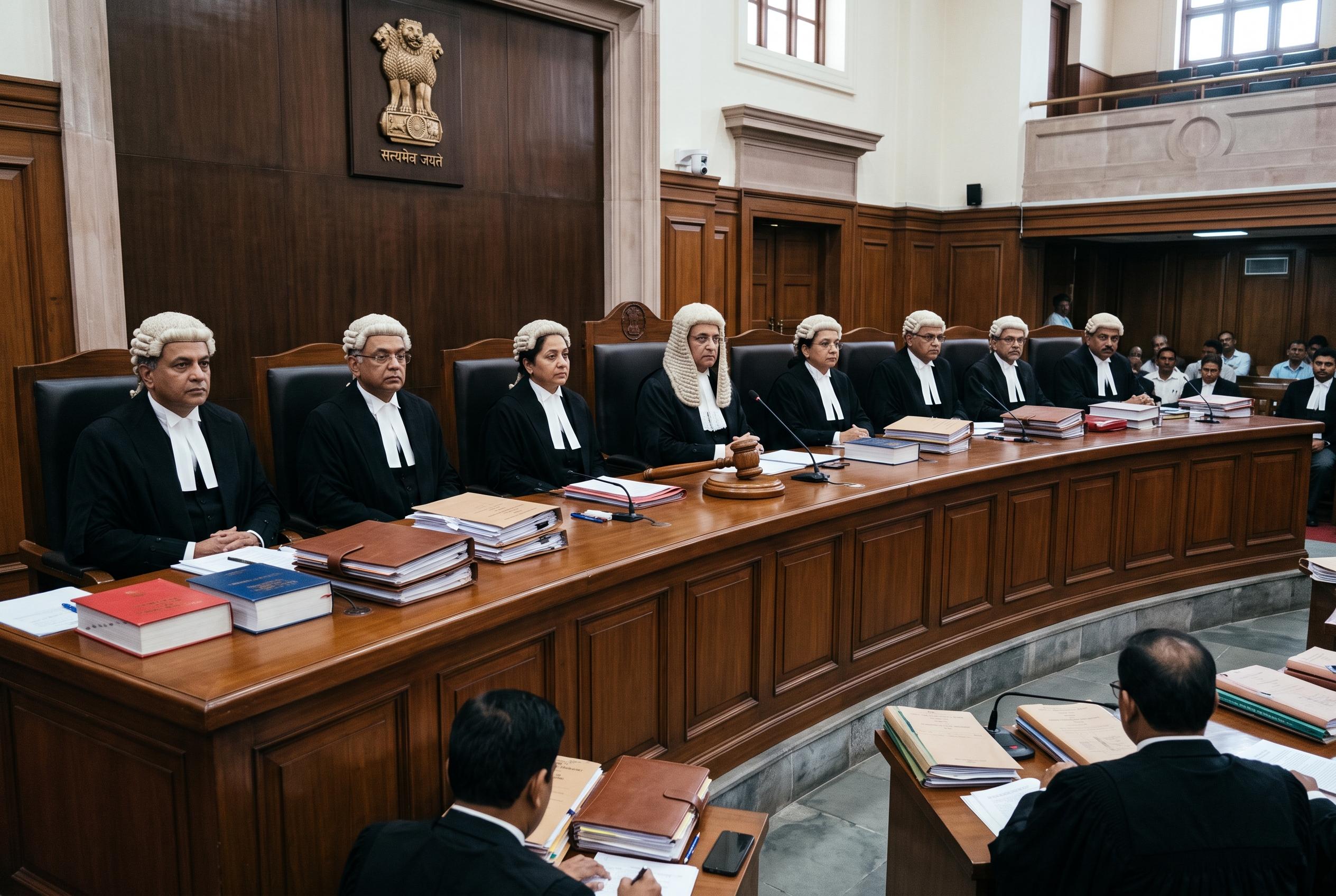

The nine-judge bench of the Supreme Court of India will clarify the scope of ‘industry’ under the now-repealed Industrial Disputes Act, a verdict with the potential to influence workplace rights and state functions across India.
The Supreme Court of India is due on Thursday, August 20, 2026, to deliver a long-awaited ruling on how far the term “industry” extends under a now-repealed labour law that shaped workplace rights for decades. The nine-judge bench, headed by Chief Justice of India Surya Kant, will decide a reference that could clarify whether a wide range of government and public-facing activities fall within the scope of the old Industrial Disputes Act, 1947.
At the heart of the case is the court’s landmark 1978 ruling in Bangalore Water Supply and Sewerage Board v. A. Rajappa, which gave “industry” an unusually broad meaning. That judgment held that organised activities carried out through cooperation between employer and employee for the production or supply of goods and services would generally qualify, and it brought bodies such as municipalities, hospitals and educational institutions within the definition. Only core sovereign functions, including defence, policing and the judiciary, were kept outside it.
Several states, including Uttar Pradesh, Maharashtra and Punjab, have asked the court to reconsider that approach, arguing that the earlier ruling went too far. The bench has been asked to consider whether social welfare schemes and other activities run by government departments or their instrumentalities can amount to industrial activity, and whether sovereign functions themselves should be treated as industries under Section 2(j). Supporters of the older ruling, among them Indira Jaising, C.U. Singh and Gopal Sankaranarayanan, have argued that keeping a broad definition preserves access to remedies over wages, safety, job security and dismissal.
Jaising told the bench that a democratic state had a duty to provide a judicial forum where workers could air grievances over substantive rights. The hearing has also taken place against a changed legal backdrop: the Industrial Relations Code has now replaced the Industrial Disputes Act and related labour laws, but the court is still being asked to give an authoritative answer on where the line should be drawn between sovereign activity and industry. Attorney-General R. Venkataramani has argued that sovereign functions cannot be captured in a fixed, exhaustive definition because the state’s role continues to evolve.
Disclaimer: This article is intended to inform and educate, not to recommend or endorse any financial product, investment or strategy. Please consider your own financial circumstances and seek professional advice where appropriate before making financial decisions.