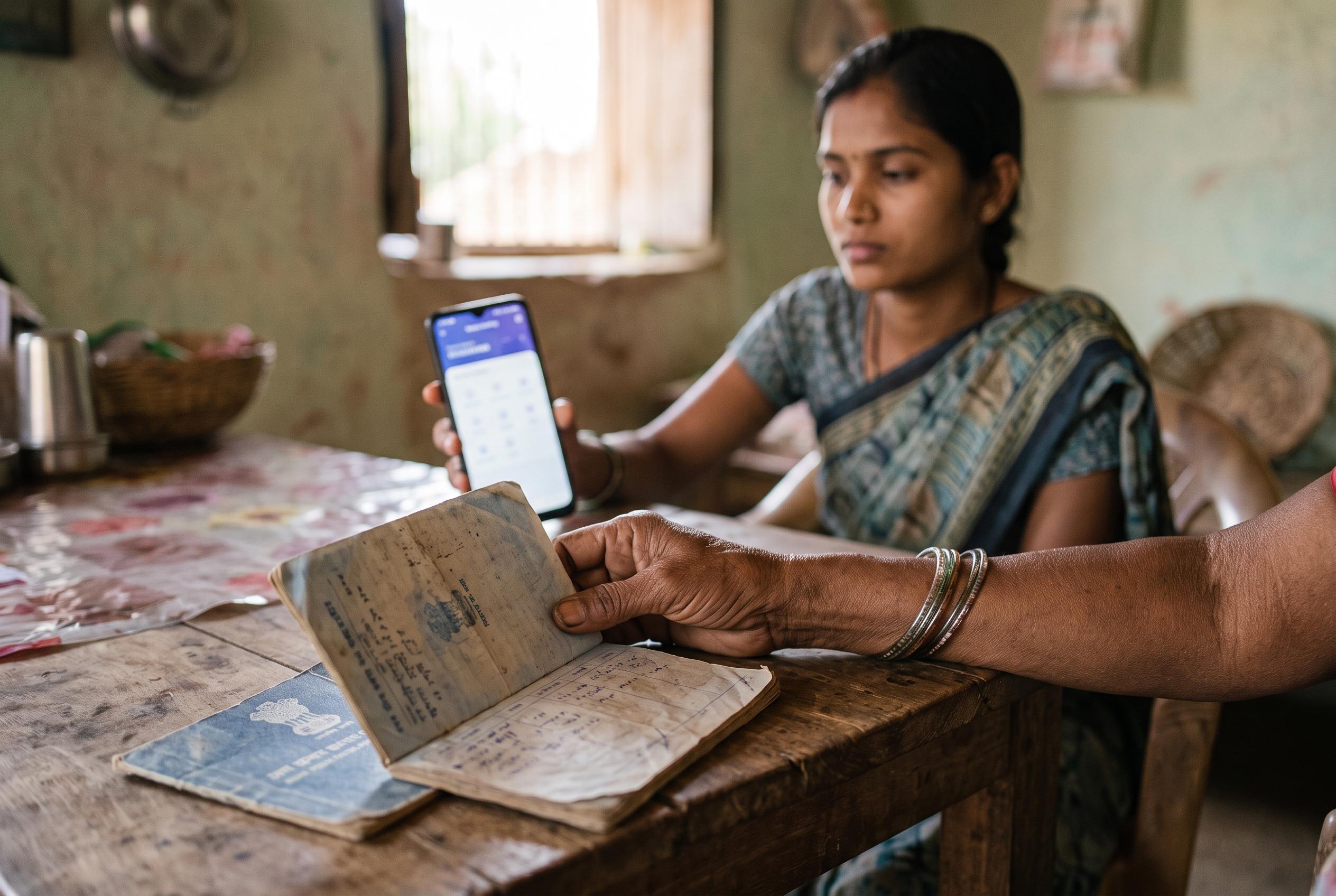

Despite crossing 59 crore accounts and collecting over ₹3.15 lakh crore in deposits, India’s flagship banking scheme struggles with mounting dormant accounts, raising questions about its effectiveness in reaching the poorest households.
India’s flagship drive to pull poorer households into the banking system has crossed 59 crore Jan Dhan accounts, but a Right to Information reply dated 1 September 2026 shows how many of them are barely being used. The reply, based on figures up to 12 August, said 15.37 crore Pradhan Mantri Jan Dhan Yojana accounts were inoperative and 5.72 crore had no balance, even though the scheme as a whole held more than ₹3.15 lakh crore. (nationalrevealed.com)
Those figures sit awkwardly beside the government’s own anniversary messaging. On 27 August 2026, the finance ministry said PMJDY had completed 12 years with 59.09 crore accounts, ₹3.17 lakh crore in deposits, 41.29 crore RuPay cards and an average balance of ₹5,356 per account. The official dashboard shows 32.92 crore women account-holders and 45.95 crore accounts in rural or semi-urban branches, underlining how deeply the scheme is woven into welfare delivery through the Jan-Dhan-Aadhaar-Mobile system. (pib.gov.in)
The longer trend suggests that the problem is not account opening, but account use. In a Rajya Sabha reply on 19 December 2023, the government said about 20% of 51.11 crore PMJDY accounts were inoperative, down from 40% in March 2017, and that those dormant accounts held about ₹12,779 crore, or 6.12% of total Jan Dhan deposits. Another parliamentary answer, covering March 2025, put the scheme at 55.18 crore accounts with 11.94 crore inoperative. The mid-August 2026 RTI count points to the inactive share having climbed back to just over 26%. (sansad.in)
That weakening was already visible in the public-sector banks last year. Business Standard reported that by the end of September 2025, state-owned lenders had 54.55 crore Jan Dhan accounts, of which about 14.28 crore were inactive, also around 26%. Among larger banks, Bank of India and Union Bank of India had the highest inactive ratios at 33% and 32% respectively, while Indian Overseas Bank and Punjab & Sind Bank were much lower at 8% and 9%. State Bank of India’s share had risen to 25% from 19% a year earlier. (business-standard.com)
By the end of March 2026, the problem extended beyond state lenders. LiveHindustan reported 14.38 crore inactive Jan Dhan accounts in government banks and another 63 lakh in private banks, where the inactive share was put at 36%. Its bank-by-bank breakdown suggested especially high inactivity at some private lenders, including 65% at ICICI Bank and 49% at Kotak Mahindra Bank, although HDFC Bank and IDFC First Bank were far lower at 9% and 7%. Under RBI rules, a savings account becomes inoperative after two years without customer-initiated transactions. (livehindustan.com)
The Department of Financial Services has insisted the answer is not mass closure. In a statement issued on 8 July 2025, it said it had “NOT asked Banks to close inactive PM Jan Dhan Yojana accounts” and instead launched a three-month campaign from 1 July 2025 to deepen use of Jan Dhan, insurance and pension schemes. The department said banks were to update due KYC, contact account-holders and revive dormant accounts. By 15 September 2025, the campaign had run more than 2.30 lakh camps, opened 61.69 lakh new PMJDY accounts and completed re-verification for 2.32 crore inactive accounts. (pib.gov.in)
That push did not stop banks from trimming parts of the system. Business Standard reported that public-sector banks shut about 1.5 million inoperative zero-balance Jan Dhan accounts in April 2025 as a one-off exercise to remove duplicate and non-functional accounts. Even so, the ministry maintained that no incidents of mass closure had come to its notice, drawing a distinction between clean-up exercises and any wider cull of dormant accounts. (business-standard.com)
The contrast with the government’s earlier milestones is stark. In August 2022, PIB said 81.2% of Jan Dhan accounts were operative and only 8.2% were zero-balance, at a point when the scheme had 46.25 crore accounts and ₹1.74 lakh crore in deposits. Four years later, the network is much larger and carries far more money, but the latest RTI figures suggest inactivity and empty balances have again become a material drag. For a scheme designed to move benefits directly to poorer households, access alone is no longer a sufficient test of success. (pib.gov.in)
Disclaimer: This article is intended to inform and educate, not to recommend or endorse any financial product, investment or strategy. Please consider your own financial circumstances and seek professional advice where appropriate before making financial decisions.