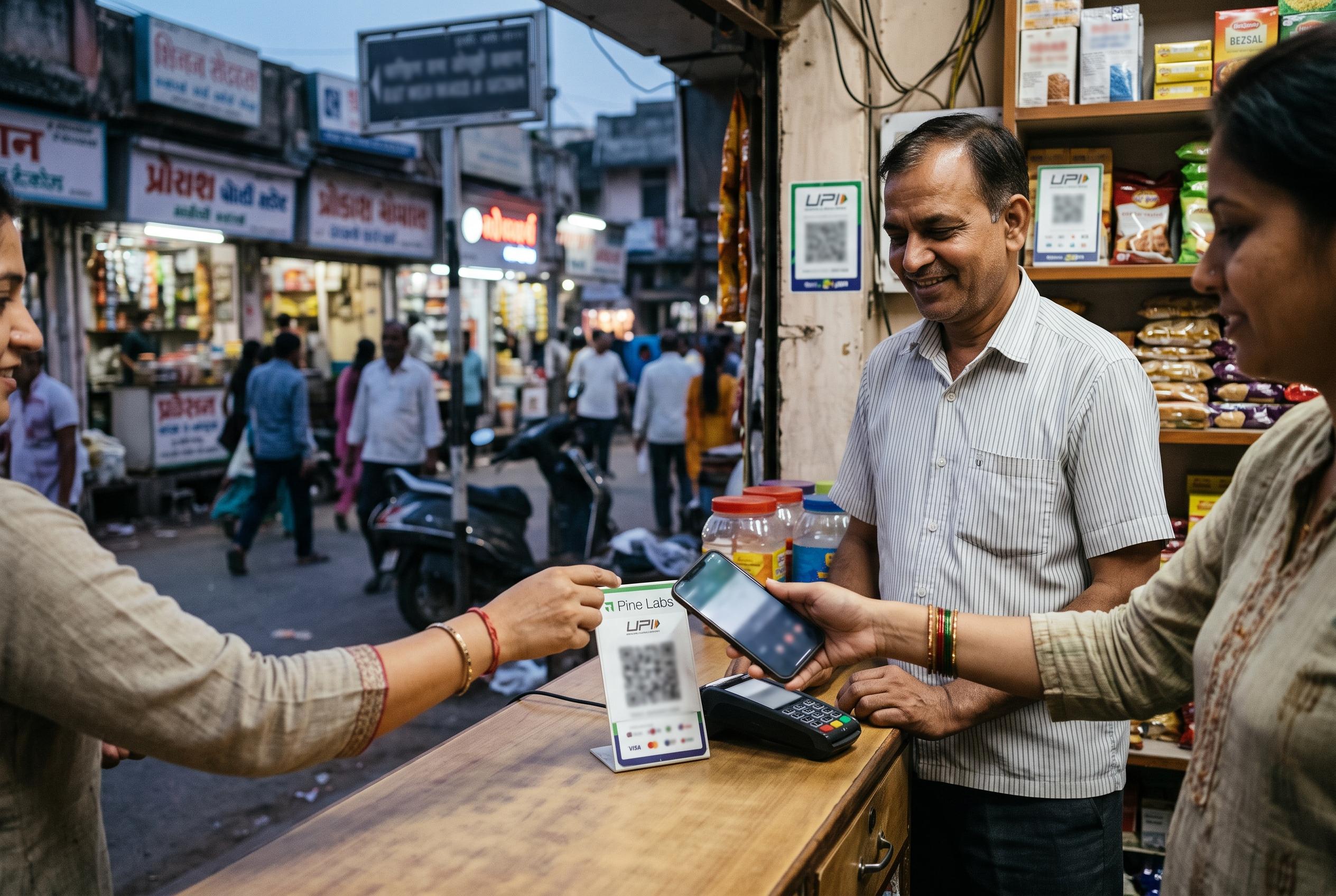

From October 15, India’s National Payments Corporation of India introduces a 0.4% merchant discount rate on high-value merchant transactions, shaping a new era for digital payments that preserves free everyday use while ensuring system sustainability.
India’s Unified Payments Interface is set for a major fee change on high-value merchant transactions from October 15, with the National Payments Corporation of India introducing a 0.4 per cent merchant discount rate on certain person-to-merchant payments above ₹2,000. According to reporting by Business Standard, the new charge will not affect ordinary person-to-person transfers, while small merchants in the person-to-person-merchant category will keep their zero-fee status even when a customer pays more than ₹2,000 in a single transaction.
The distinction matters because the fee applies to the merchant’s classification, not just the size of one payment. Business Standard said small vendors whose bank or payment provider has placed them in the P2PM category can continue to receive up to ₹1 lakh a month through UPI QR codes without MDR, and they do not need GST registration to qualify. If collections stay above that threshold for three straight months, the merchant can be shifted into the regular P2M category, where the new fee framework applies to eligible transactions above ₹2,000.
That means a one-off payment above the threshold does not automatically trigger charges for a small merchant still classified as P2PM. A shopkeeper receiving ₹3,000 or ₹5,000 from one customer would still avoid MDR if the account remains in the exempt category. Once moved to P2M, however, the charge structure becomes clearer: no MDR up to ₹2,000, 0.4 per cent above that, and a cap of ₹300 on payments of ₹75,000 or more. Business Standard also said certain sectors, including railways, telecoms, insurance and fuel, face a flat ₹5 fee on transactions above ₹2,000.
Livemint and The Times of India both reported that NPCI’s stated aim is to make the UPI ecosystem financially sustainable while keeping everyday consumer use free. The new framework also leaves customers untouched, with the merchant bearing the cost rather than passing it on at checkout. Existing QR codes and soundboxes are not expected to need replacement, and small merchants are being told to check with their bank or payment service provider if they are unsure whether they have been classified as P2PM or P2M.
Disclaimer: This article is intended to inform and educate, not to recommend or endorse any financial product, investment or strategy. Please consider your own financial circumstances and seek professional advice where appropriate before making financial decisions.