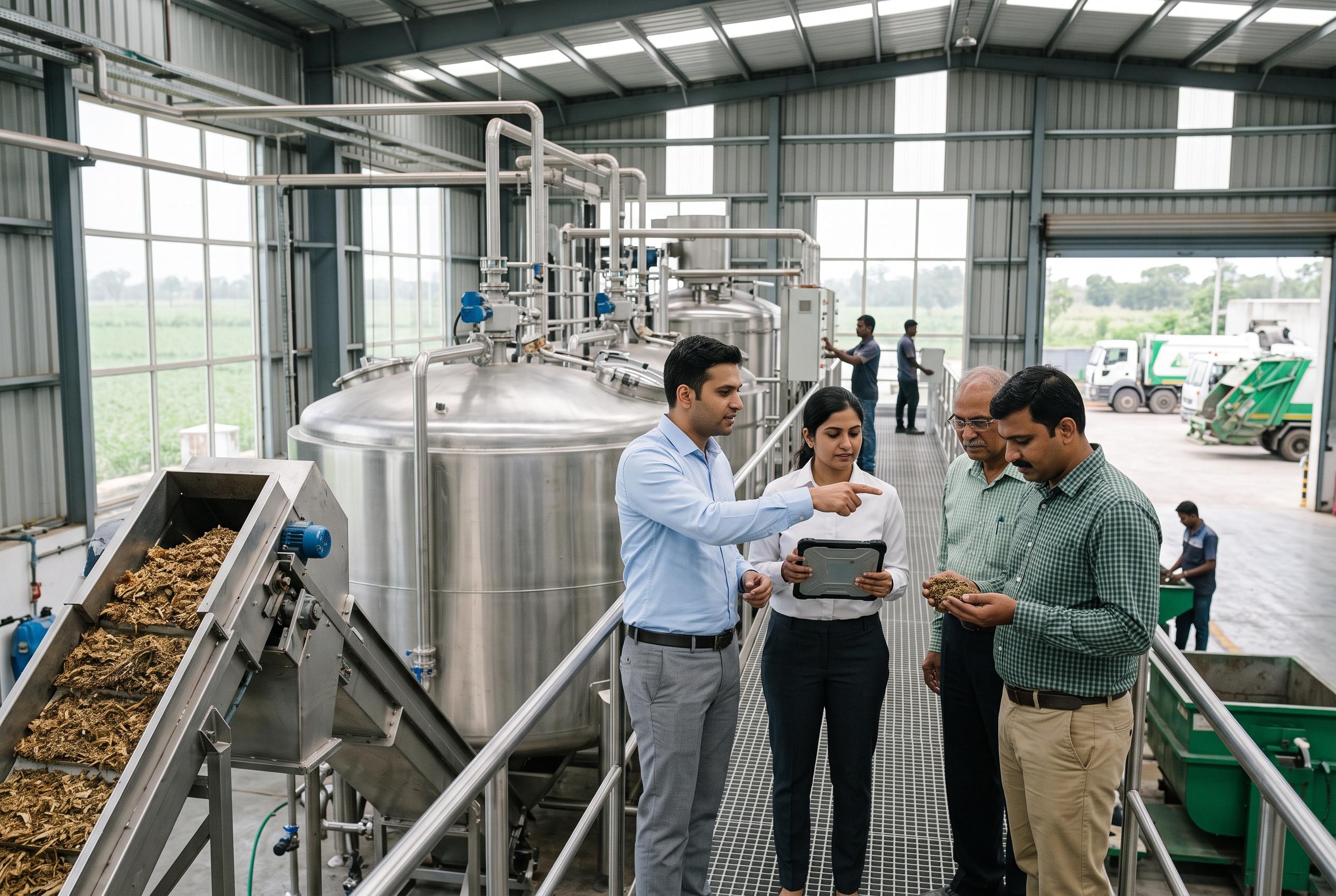

India is moving from subsidy-heavy pilot projects to a more commercial phase in converting crop residue, municipal waste, and agro-industrial waste into fuel and fertiliser, highlighting both progress and ongoing hurdles in scaling sustainable waste management solutions.
India’s push to turn crop residue, municipal rubbish and agro-industrial waste into fuel and fertiliser is edging beyond the subsidy-heavy pilot stage and into a tougher commercial phase. Government data show sales of organic manure from biogas and compressed biogas plants rising sharply, while official support has shifted towards market-building tools such as marketing assistance, farmer outreach and offtake arrangements rather than grants alone. That change has created room for private developers to raise larger pools of capital, but it has also exposed them to a more basic test: whether waste-to-value projects can make money consistently once they are built.
CEF Group has become one of the clearer examples of that transition. The company said in August 2025 that it had secured €38 million in combined equity and debt from German Export Finance Bank to back two compressed biogas plants, part of a wider ambition to develop 22 across India under the SATAT scheme. Economic Times reported that the company, founded in 2018, already had three projects in advanced execution, including municipal solid waste plants in Jammu and Ahmedabad and a press-mud facility in western Uttar Pradesh. IAMRenew added that the two named projects, CEF Jammu Energy and CEF Ahmedabad Cleaneffentech, are being structured with export-credit-backed financing, with Trade Finance Swiss, part of the Rieckermann Group, acting as project manager and general supplier.
That funding package is tied not just to fuel output but to the wider economics of waste handling. IAMRenew said the Jammu and Ahmedabad plants are designed to process up to 850 tonnes of municipal solid waste a day and to produce compressed biogas alongside organic manure and refuse-derived fuel. Maninder Singh, CEF’s founder and chief executive, cast the investment in broad terms, saying the group was “not just building biogas plants” but also helping rural economies and energy security. YourStory’s profile of the business suggested the company is trying to build a fuller ecosystem around that claim, with 16 projects operating nationwide, five more in advanced construction and manufacturing units in Srinagar and Uttar Pradesh making bio-fertilisers and plant boosters.
The company’s Srinagar operation also shows why developers are trying to earn from several waste streams at once. YourStory reported that CEF’s Dal Lake project, launched in June 2023, converts about 70,000 tonnes of annual lake waste, including weeds and lilies, into organic manure and related products, and that the model has drawn interest for replication in five other locations. The same report said the group produces more than 100,000 tonnes of organic fertilisers and bio-stimulants a year and wants to increase that to 500,000 tonnes within three to four years. For companies like CEF, the commercial case depends on whether those by-products can move from being a disposal outlet to a dependable revenue line.
That remains difficult across the sector. Renewable Watch reported that compressed biogas was fetching about Rs 74 to Rs 81 per kg under SATAT and city gas synchronisation arrangements in 2025, roughly 85 per cent of the prevailing retail CNG price. Developers told the publication that the structure undervalued a fuel that also cuts emissions and deals with waste, making it harder to recover large upfront capital costs. The same problem extends to fermented organic manure and liquid fermented organic manure: although more producers are trying to sell them, uptake has been uneven because demand is seasonal, transport is expensive and drying, granulation and packaging only become meaningfully profitable when they are mechanised at scale.
Official policy has increasingly focused on that missing commercial infrastructure. The Department of Fertilizers said in March 2026 that India was paying market development assistance of ₹1,500 per metric tonne for fermented organic manure, liquid fermented organic manure and phosphate-rich organic manure produced by GOBARdhan and compressed biogas plants. It said 120 plants had registered on the Integrated Fertilizer Management System portal to sell those products, and that 44 memoranda of understanding had been signed with fertiliser marketing companies. The department also said 24 companies had held 15,690 farmer camps and meetings between February 2025 and January 2026 to explain dosage, crop-specific use and the practical benefits of organic inputs.
Even with that backing, project execution remains fraught. Renewable Watch said financiers were still wary of timelines slipping beyond two years, volatile feedstock prices and weak access to pipelines or large customers. Rural retail outlets, it said, often sell only 500 to 800 kg of compressed biogas a day, too little to support bigger plants without other offtake channels. Singh has also spoken publicly about financing and market barriers. YourStory reported that CEF struggled to obtain debt from Indian banks and turned instead to overseas lenders, including AKA Bank in Germany, while keeping its agritech and retail operations self-funded. He also told the publication that “unlicensed producers create unfair competition” in the fertiliser market, a complaint that points to the gap between policy support and enforcement on the ground.
Government messaging has, at times, mixed optimism with evidence of that uneven rollout. A December 2024 briefing on GOBARdhan described compressed biogas as a sunrise industry and pointed to measures including blending rules, excise relief, pipeline support and carbon-credit incentives, but it also highlighted persistent problems around feedstock, financing and site identification. The same official note used different plant counts for different parts of the programme, referring both to 37 functioning compressed biogas plants against a specific budget target and to 125 functional plants more broadly, underlining how quickly the sector has expanded and how hard it can be to compare like with like. By March 2026, the fertiliser department said manure sales supported by its assistance scheme had reached 1.67 million metric tonnes for the year to February 28, up from 336,291.30 metric tonnes in 2024-25.
What happens next will depend less on slogans about circularity than on whether operators can lock in reliable feedstock, steady gas offtake and repeat sales of manure at a price farmers will accept. CEF’s financing shows there is overseas appetite for the story, and the government’s recent policy architecture suggests Delhi wants the industry to scale. But the sector’s own trade reporting makes clear that the real measure of success will be mundane rather than ideological: plants commissioned on time, logistics that work, and products that compete in a market still shaped by conventional fuels, established fertiliser habits and thin margins.
Disclaimer: This article is intended to inform and educate, not to recommend or endorse any financial product, investment or strategy. Please consider your own financial circumstances and seek professional advice where appropriate before making financial decisions.