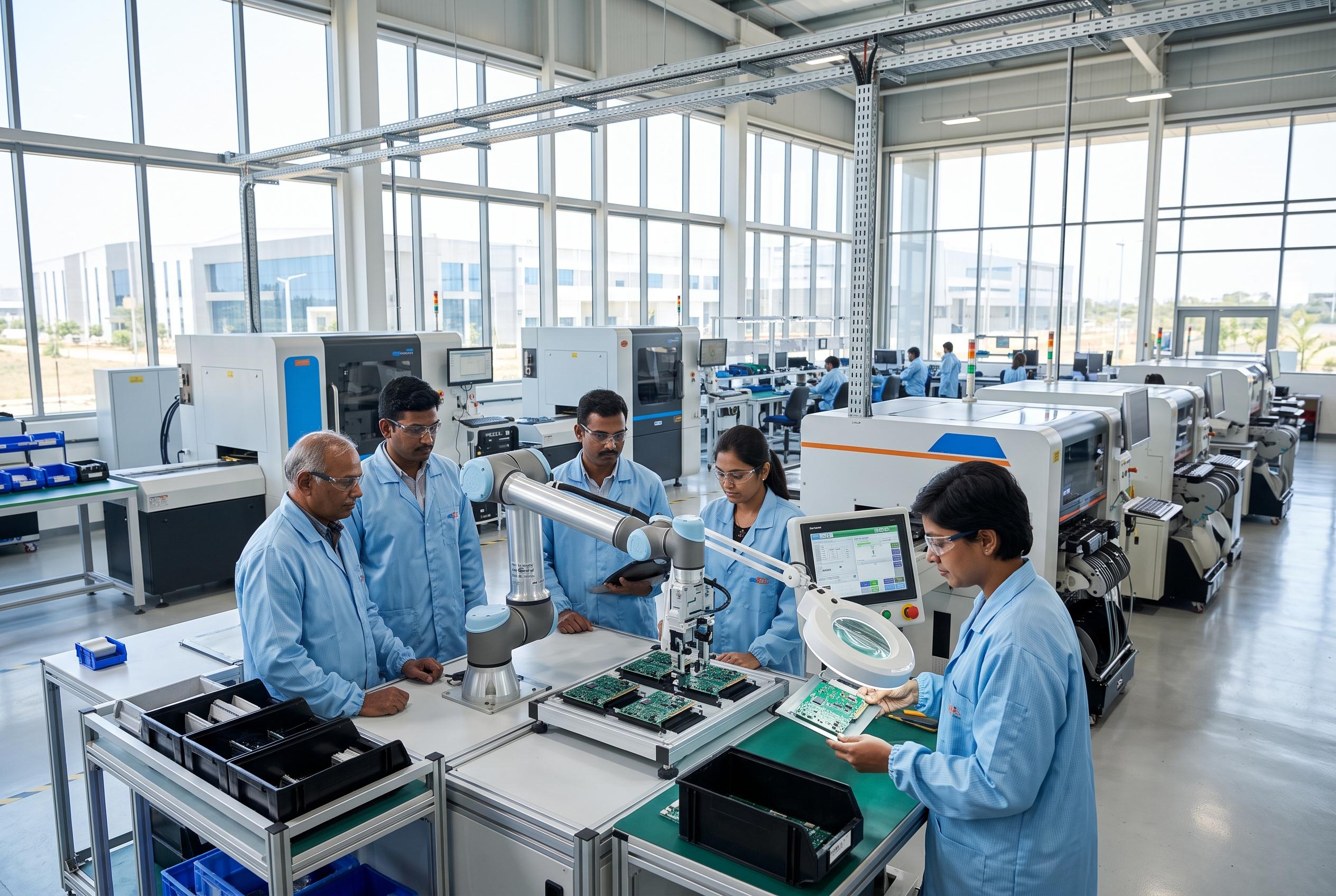

A new KPMG India report warns that unless factory worker productivity improves significantly, India will fall short of its US$7.5 trillion manufacturing target by 2047, risking its broader economic ambitions.
India’s ambition to build a US$7.5 trillion manufacturing sector by 2047 is likely to fall badly short unless factories get far more output from the people and assets they already have, according to a KPMG India report published this week. The consultancy says that, on the sector’s current path, manufacturing would reach only about US$2.7 trillion by 2047, leaving a gap of roughly US$4.8 trillion against the national target.
That shortfall matters because manufacturing is supposed to do much of the heavy lifting in India’s wider plan to become a US$30 trillion economy by 2047, with factories accounting for about a quarter of gross domestic product. KPMG’s report, released on 3 September, says that would require manufacturing to expand almost 15-fold from roughly US$501 billion in 2025, implying annual growth of about 13.1 per cent rather than the recent pace of 7.9 per cent. Its central argument is that new capacity, stronger demand and more automation will not be enough on their own.
Instead, the firm argues that workforce productivity is the missing lever. It says a sustained 30 per cent improvement in productivity could account for nearly 35 per cent of India’s future manufacturing output, and that companies adopting a structured overhaul could unlock gains of 15 to 30 per cent. KPMG based the study on more than 130 large Indian manufacturers over a decade and said the strongest performers translated higher productivity into sharper financial results: annual net profit growth of about 10 to 11 per cent, compared with roughly 7 per cent for average performers, and market-capitalisation growth of around 19 per cent against about 10 per cent for peers.
The report argues that the problem is not limited to a long tail of weaker factories. More than 70 per cent of large manufacturers, it says, would still need significant operational change to reach the productivity levels implied by India’s 2047 ambition. Smaller and unorganised factories remain much further behind, producing less than one-fifth of the output per worker seen in large firms. Even within the organised sector, productivity differences can range from 300 to 1,000 per cent between companies. Sharad Maloo, a partner in KPMG India’s human capital advisory practice, said many businesses were caught in a “productivity illusion”, where busy plants conceal deep inefficiencies.
Those inefficiencies are described in unusually concrete terms. In one example from the report, a diversified engineering company had 11 layers between the shop floor and the chief operating officer, stretching its request-for-quotation cycle to 28 days, against seven for a rival. Elsewhere, KPMG says routine purchase requests can require six signatures, while night-shift decisions raised at 2am may wait until a 9am review, by which point output has already been lost. The report says some plants show a 10 to 20 per cent throughput gap between shifts, and that effective capacity can sit 5 to 15 per cent below nameplate levels once shift quality is taken into account.
Labour deployment is another recurring weakness. KPMG says some operations rely so heavily on contractors that skills never properly accumulate on the line: in one auto stamping plant, 65 per cent of the die-change crew were contract workers with an average tenure of only nine months. In another example, a heavy engineering facility depended on one foreman with 32 years’ experience for a critical heat-treatment cycle, while a steel mill took 30 per cent longer to commission a new line when a senior fitter was absent. The report says this dependence on informal know-how leaves manufacturers exposed when experienced staff retire, move on or simply are not on shift.
To tackle that, KPMG proposes what it calls a Productivity Triad: reimagining work, redesigning the organisation and remodelling the workforce. In practice, that means stripping out low-value activity, simplifying layers and reporting lines, clarifying decision rights and matching skills more closely to the work actually being done. The report also places artificial intelligence well beyond the factory floor, arguing that it can support production, quality control, finance, human resources, procurement, engineering and customer service. In its task-level estimates, KPMG says AI could do 40 to 65 per cent of work in quality and inspection, help with 40 to 60 per cent of finance and accounting activity, and support 35 to 55 per cent of procurement and inbound supply work.
The consultancy’s message is that technology will matter only if companies alter the way they are run. Its suggested first-month reset begins with appointing one owner for the productivity drive and publishing a hard baseline, before setting a single north-star metric, testing the leadership team’s willingness to confront resistance, running a pilot on one plant or production line and aligning incentives around the same objective. As Sunit Sinha, who leads human capital advisory solutions at KPMG India, put it: “Workforce productivity is India’s most underleveraged growth lever.”
Disclaimer: This article is intended to inform and educate, not to recommend or endorse any financial product, investment or strategy. Please consider your own financial circumstances and seek professional advice where appropriate before making financial decisions.