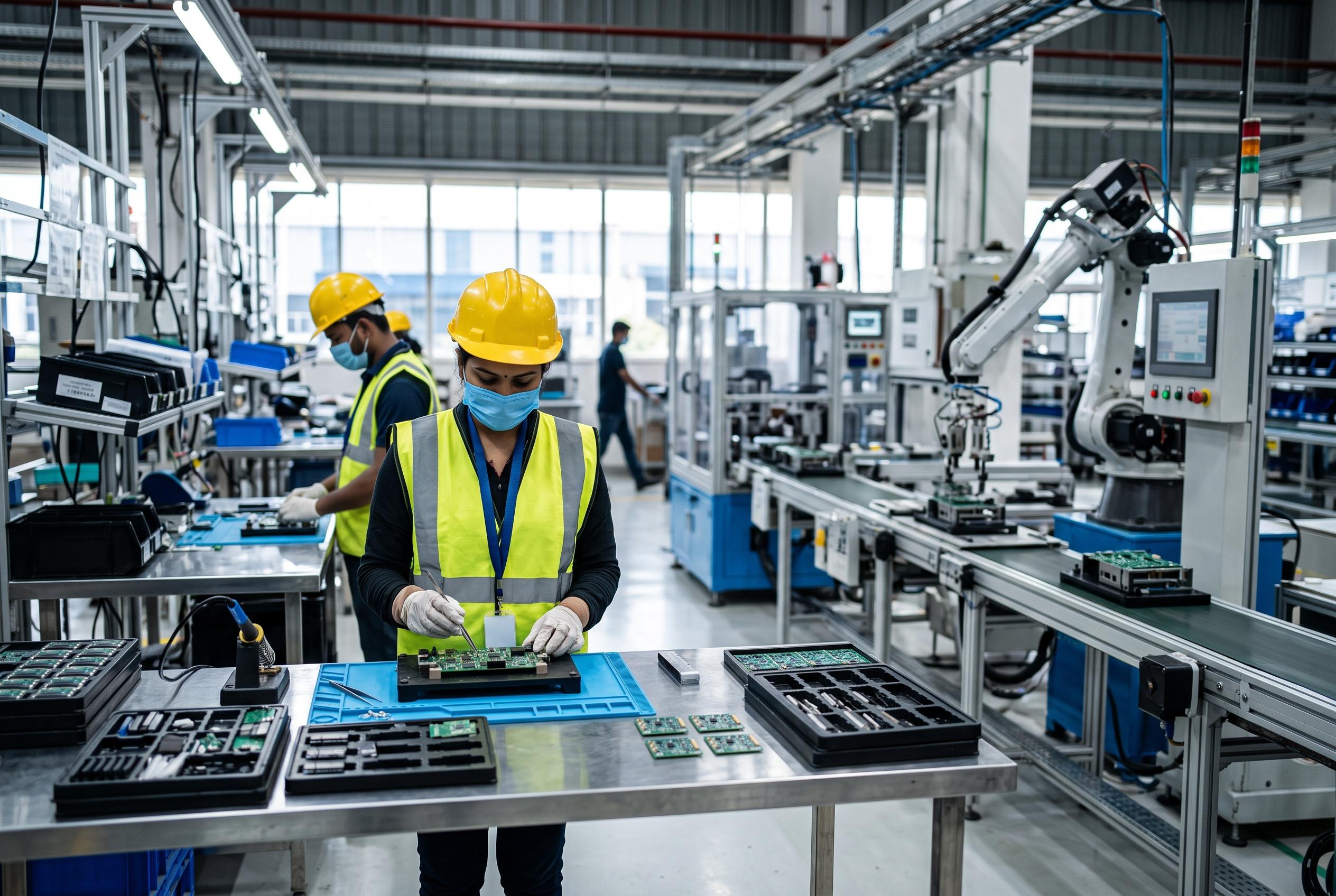

India’s Electronics Component Manufacturing Scheme gains momentum, with fresh approvals and regional hubs driving its push for self-reliance and export growth by 2030.
India is stepping up its push to build more of its own electronics components, as the Electronics Component Manufacturing Scheme gathers pace with fresh approvals and a wider industrial ambition. In its latest round, the government cleared 29 new applications under the scheme, representing a combined investment of ₹7,104 crore and an expected 14,246 jobs, according to The Economic Times.
The policy sits at the centre of a broader effort to move the country beyond assembly work and into deeper manufacturing. The Press Information Bureau said the scheme was notified on 8 April 2025 with an initial outlay of ₹22,919 crore, a six-year duration and a one-year gestation option, later expanded to ₹40,000 crore in the 2026-27 Union Budget. The stated aim is to raise domestic value addition, cut import dependence and strengthen supply chains for parts such as printed circuit boards, connectors, capacitors, camera modules, display modules, lithium-ion cells and rare-earth magnets.
Several Indian manufacturers are already moving to take advantage of the incentives. Mint reported that Amber Enterprises, Kaynes Technology, SRF and Syrma SGS have secured approvals under the scheme and expect to begin producing items including printed circuit boards, camera module sub-assemblies and high-density connectors by mid-2026. Moneycontrol has also reported that Tamil Nadu has emerged as an early hub, with multiple projects concentrated in the state.
The scheme is one piece of a larger industrial policy framework that includes the National Policy on Electronics 2019, the Production Linked Incentive programme for large-scale electronics manufacturing, SPECS, EMC 2.0 and the semiconductor support programme. According to government material, these measures are intended to attract investment, build supply-chain depth and integrate Indian firms more tightly with global value chains.
Officials say the momentum is already visible. The Press Information Bureau said 106 projects had been approved across 15 states by August 2026, with approved investment of ₹69,548 crore, production already under way at 38 plants and another 16 projects nearing construction or equipment installation. The government wants the electronics industry to reach a $500 billion domestic manufacturing base and $150 billion in exports by 2030, and the latest approvals suggest it is trying to turn that ambition into industrial capacity rather than rely on imports for critical parts.
Disclaimer: This article is intended to inform and educate, not to recommend or endorse any financial product, investment or strategy. Please consider your own financial circumstances and seek professional advice where appropriate before making financial decisions.