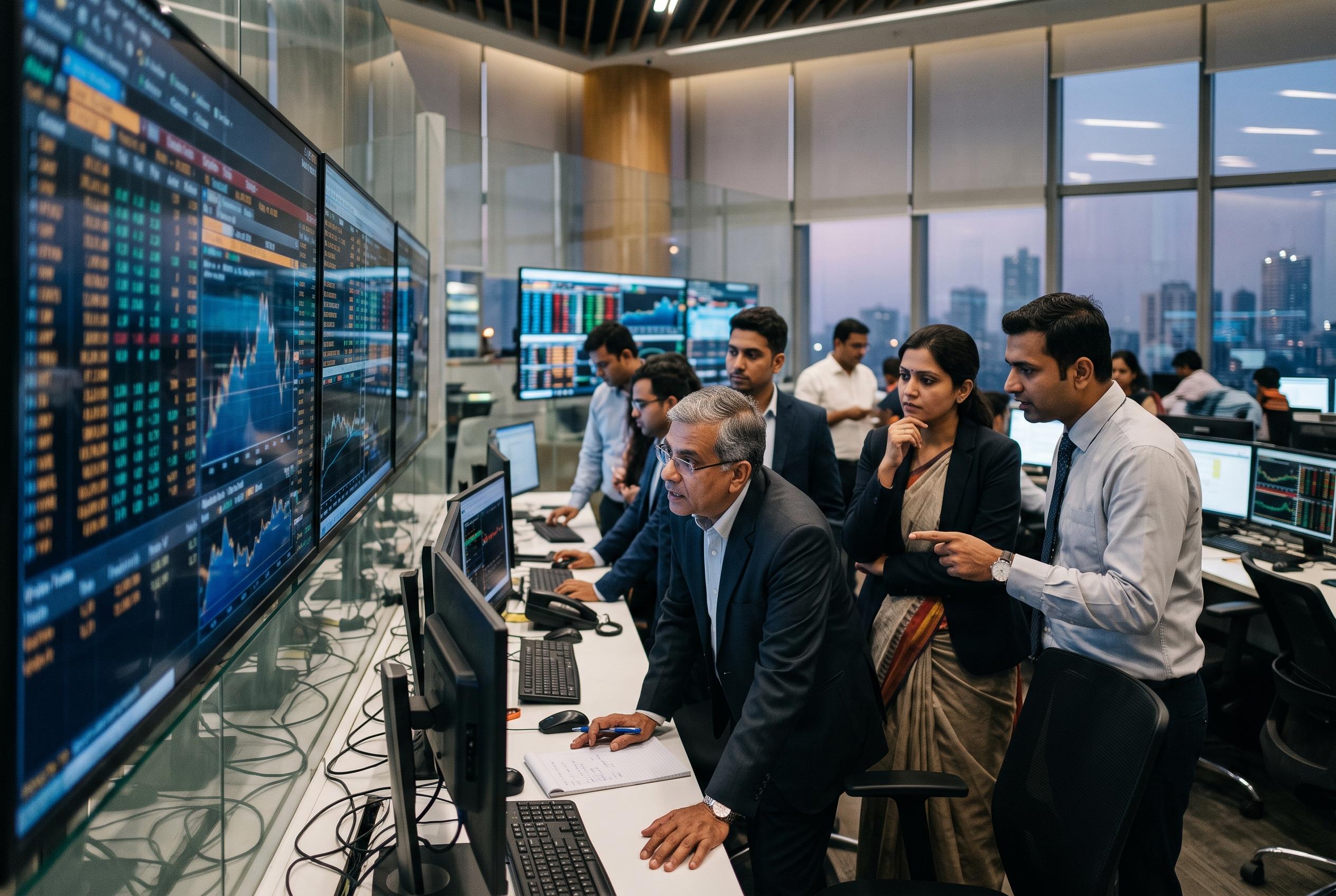

The National Stock Exchange of India has reduced its valuation request by roughly 15%, yet it remains the most expensive exchange globally, prompting debate over whether its market dominance justifies the premium.
The National Stock Exchange of India has trimmed the valuation it sought for its long-awaited float by roughly 15%, yet the market still sees it as the most expensive exchange franchise in the world. At the top of the price band, ₹1,785 a share, the exchange is valued at about 42.9 times earnings, a level that places it well above many global listed rivals, even as analysts say its scale and position in India’s capital markets justify a premium. According to Business Standard, the debate is less about whether NSE is costly than whether its dominance warrants the extra price.
That argument rests on NSE’s grip on India’s trading landscape. Reuters-style market commentary in the Business Standard report said the exchange has long benefited from a highly liquid marketplace and strong network effects, with investors and brokers reinforcing its lead as domestic participation expands. Rajesh Agarwal, head of research at AUM Capital Market, said the valuation premium is defensible because India’s capital markets are growing faster than mature markets such as Nasdaq, the London Stock Exchange and Deutsche Börse, helped by household financialisation and still-low market penetration.
The comparison with global peers is striking. Bloomberg data cited by Business Standard showed Coinbase Global trading at 40.35 times earnings, Singapore Exchange at 34.56 times, London Stock Exchange Group at 29.35 times and Nasdaq at 25.95 times. Several other major exchange operators, including CME Group, Intercontinental Exchange, Hong Kong Exchanges and Clearing, Deutsche Börse, Cboe Global Markets and Japan Exchange Group, were said to trade largely in the low- to mid-20s on the same measure. Even so, NSE’s own profitability is unusually strong, with a 62.1 per cent profit margin and a 32.1 per cent return on equity in fiscal 2026, according to the Business Standard report.
Domestic rivals are even more expensive on a simple earnings basis. Business Standard said BSE Ltd trades at 54.33 times earnings and Multi Commodity Exchange at 60.77 times, although Agarwal said BSE’s richer multiple is partly explained by faster growth from a smaller base. Ventura, another brokerage cited in the report, argued that NSE’s premium is supported by its scale and operating strength, noting that the exchange was India’s largest by total turnover in cash equities and equity derivatives from fiscal 2001 through fiscal 2026, and the world’s largest multi-asset exchange by cash-equity trades and equity-derivative contracts in fiscal 2026.
Disclaimer: This article is intended to inform and educate, not to recommend or endorse any financial product, investment or strategy. Please consider your own financial circumstances and seek professional advice where appropriate before making financial decisions.