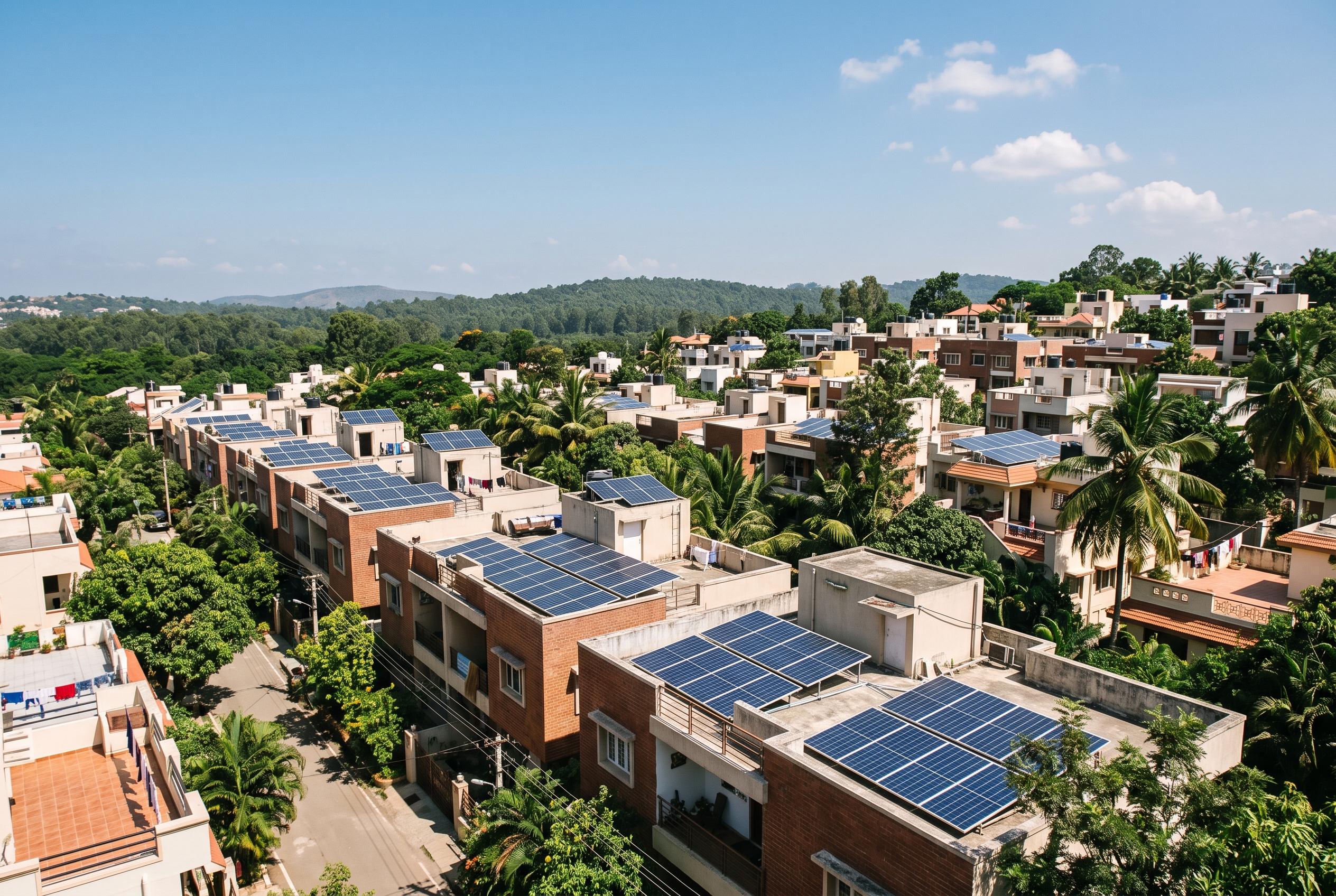

India’s residential rooftop solar sector is poised for significant growth between 2026 and 2030, supported by government schemes and mounting demand, with the potential to reach a 132GW market size.
India’s residential rooftop solar market could be on course for another strong expansion phase, with the Indian Solar Manufacturers Association projecting annual installations of 9GW to 15GW between 2026 and 2030. The forecast underscores how the government’s PM Surya Ghar: Muft Bijli Yojana has become central to demand in a segment that was once constrained by cost, access and uneven uptake.
According to ISMA’s Market Sizing and Growth Outlook report, the long-term residential rooftop opportunity is about 132GW, leaving roughly 115GW still to be deployed. The association said the market could support steady demand for solar cells, modules, inverters and balance-of-system equipment, while also reinforcing opportunities for manufacturers, engineering and procurement firms, installers, system integrators and other service providers.
The latest deployment figures show how quickly the policy has changed the sector. India had 30.1GW of grid-connected rooftop solar capacity as of 30 June 2026, with the PM Surya Ghar scheme having added 13.5GW by July. Business Standard reported on 5 August that the programme had received 7.77 million applications and led to 4.19 million rooftop installations, covering 5.04 million households and unlocking ₹28,390.50 crore in central assistance. Earlier figures published in February showed more than 2.08 million systems installed by the end of 2025, with Gujarat, Maharashtra and Uttar Pradesh leading adoption.
ISMA said about 8GW of the residential market can already pay for itself without subsidy, largely in higher-usage homes in states with expensive electricity. The rest still depends on support from the scheme. Amit Manohar, the association’s secretary-general, said early clarity on the programme’s next phase would help keep the market moving, particularly as the current plan approaches March 2027. ISMA also warned that policy continuity beyond that point will matter for investment decisions, manufacturing capacity and domestic supply chains. The report said its estimate is based on household electricity use, government housing-suitability surveys and distribution tariffs.
Disclaimer: This article is intended to inform and educate, not to recommend or endorse any financial product, investment or strategy. Please consider your own financial circumstances and seek professional advice where appropriate before making financial decisions.