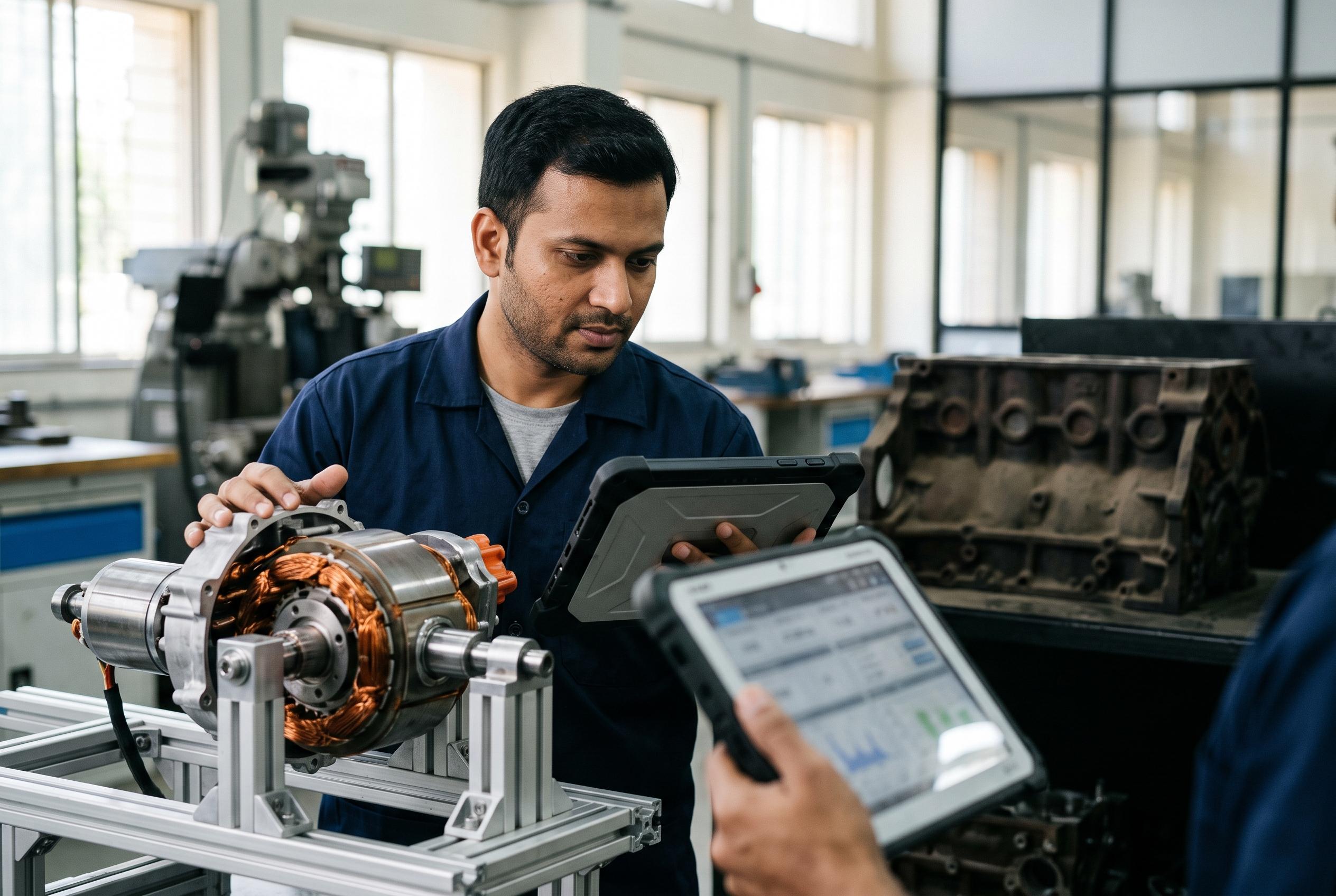

A new report reveals that Indian auto-parts MSMEs are ill-equipped for the shift to electric, hybrid, and autonomous vehicles, risking falling behind as global demand for high-tech components rises.
India’s micro, small and medium-sized auto-parts suppliers are heading into the electric and software-led vehicle era with far less technical depth than the market now demands. Reporting by Autocar Professional, HT Auto, The Times of India and NationPress on Vector Consulting Group’s latest white paper said only about 10 per cent of suppliers are estimated to have embedded software capability, while roughly 14 per cent are thought to have systems integration and product development skills. Those are precisely the areas becoming more important as the industry moves towards electric, hybrid, hydrogen and increasingly autonomous vehicles.
The timing matters because the market around them is still expanding. The Times of India and the Economic Times’ Rajasthan edition reported that domestic sourcing by original equipment manufacturers, or OEMs, rose 16 per cent to ₹6.6 lakh crore in FY26, while component exports reached ₹2.1 lakh crore. But imports are rising faster, with China accounting for about 36 per cent of India’s auto-component imports. As more of a vehicle’s value shifts into batteries, power electronics, embedded software and integrated electronic systems, the question is no longer only how much India can make, but how much of the higher-value content its suppliers can realistically capture.
Set against that backdrop, the report argues that a large pool of investable cash is trapped in day-to-day operations. HT Auto, NationPress and IANS reported that the industry is carrying around ₹98,000 crore of inventory. Vector said companies that replenish stock according to actual consumption rather than forecasts typically cut inventory by 30 to 40 per cent. Applied across the sector, that could release between ₹29,000 crore and ₹39,000 crore of working capital, including roughly ₹4,000 crore to ₹5,600 crore within the MSME supplier base alone.
That cash squeeze is tied to what the consultancy describes as a capacity paradox. Autocar Professional, HT Auto and the IANS copy carried by The Hawk said plants are operating at only 75 to 85 per cent of installed utilisation even though about 91 per cent of executives surveyed still described capacity as a major challenge. The report attributes the gap to frequent changeovers, quality losses, rework and poor material flow, all of which eat into usable output. Ravindra Patki, Vector’s managing partner, said in remarks carried by IANS: “When operational instability ties up working capital and erodes productive capacity, suppliers have less surplus to invest in engineering, technology and product development. The idea is to change that cycle,”
Smaller manufacturers are especially exposed because many do not have the financial room to carry inefficiency and fund a technology transition at the same time. The Times of India reported that inventory can stretch to 60 days in some cases, while EBITDA margins remain around 12 per cent. It also said only about 10 per cent of suppliers have the financial capacity to invest consistently in technology, engineering and product development. That helps explain why 95 per cent of industry leaders surveyed told Vector that MSMEs are not investing quickly enough for future growth, a warning also highlighted by Autocar Professional, NationPress and the Economic Times’ Rajasthan edition.
The weakness is not confined to software. NationPress reported that advanced engineering was judged important by all respondents, yet only 38 per cent believed MSME capability had reached a developing-to-mature level. The same coverage said embedded software was seen as important by 81 per cent of respondents, although only around 10 per cent believed suppliers currently possessed it. In reporting the study, The Times of India quoted Patki saying: “India’s automotive opportunity will depend on how quickly capability can be built across the supplier ecosystem,” and added his warning that “Policy support has an important role in creating the right environment, but it cannot by itself close the capability gap.”
Vector’s central argument is that fixing operational discipline first could create the headroom for genuine reinvestment. Autocar Professional, HT Auto and NationPress reported that auto-component MSMEs generate roughly ₹2.4 lakh crore to ₹2.9 lakh crore in annual turnover, and that a 30 per cent productivity improvement across that base could support an additional ₹74,000 crore to ₹88,000 crore of yearly revenue. After material costs, the consultancy estimated a potential extra value pool of ₹29,000 crore to ₹44,000 crore. Patki said, again in comments carried by IANS: “Unlocking the cash trapped in operations, improving the economics of the existing business, and then channelling the surplus into enhancing capabilities will determine how Indian suppliers grow in the future automotive value chain,”
The white paper, released on 3 September and launched at ACMA’s 66th annual session in New Delhi, does not present this as a job for MSMEs alone. Autocar Professional and HT Auto said it calls for a broader effort from OEMs, Tier-1 and Tier-2 suppliers, technology companies and industry institutions. The broader warning in the coverage is clear: India’s auto-parts industry may keep growing in size, but the gains from electrification, electronics and software-rich vehicles will flow disproportionately to the businesses that can free up cash and plough it into engineering and product capability now. For many smaller suppliers, the choice is becoming sharper: modernise fast enough to stay relevant, or remain confined to the lower-value end of the supply chain.
Disclaimer: This article is intended to inform and educate, not to recommend or endorse any financial product, investment or strategy. Please consider your own financial circumstances and seek professional advice where appropriate before making financial decisions.