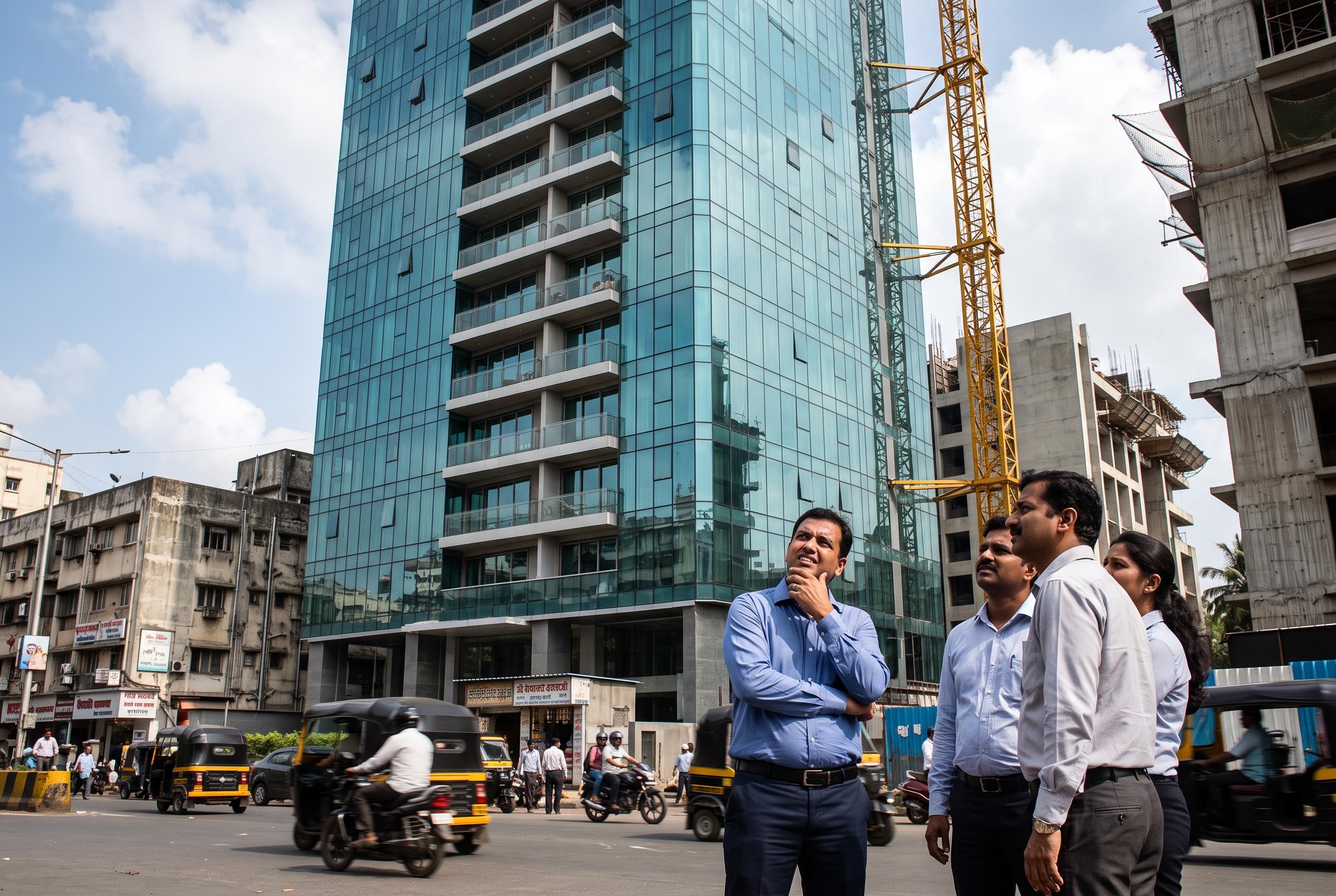

Lower Parel remains a magnet for Mumbai’s wealthy, with rising property prices and mounting monthly costs highlighting the growing divide between opulence and affordability in India’s financial capital.
Lower Parel is still drawing Mumbai’s wealthy buyers in large numbers, but the arithmetic of living there remains punishing. Market data reported by Business Standard for April to June 2026 showed 81 luxury-home registrations in the neighbourhood worth a combined Rs 769 crore, with an average ticket size of Rs 9.5 crore. Against that backdrop sits the case of Anil Jha, a wealth manager whose roughly Rs 8.5 crore apartment carries an equated monthly instalment of about Rs 4.81 lakh before the rest of the household bills are counted.
That tension helps explain why the district has become such a useful symbol of Mumbai’s premium housing market. Lower Parel was transformed from mill land into a mixed landscape of offices, luxury towers, hotels and retail, and Business Standard noted that its attraction rests as much on geography as on prestige. The area sits close to major business parks including Peninsula Business Park, Indiabulls Sky, World Crest, Urmi Estate and Marathon Futurex, and it is flanked by landmark commercial and leisure destinations such as High Street Phoenix, Palladium, the St Regis and the Four Seasons. For professionals, the promise is simple: shorter commutes, proximity to clients and employers, and an address that signals arrival.
The price of that promise has been steep for years. In a location-wise study cited by The Indian Express, the weighted average cost of a flat in Lower Parel had already risen by more than 400% in a year to Rs 7.47 crore, making the former mill heartland one of Mumbai’s sharpest examples of housing inflation. Pankaj Kapoor of Liases Foras argued that headline size can also mislead buyers. “These prime locations have seen a two-dimensional increase. While prices have definitely increased,there has been an increase in the super-built-up areas,” he said, adding that balconies, terraces and viewing decks can produce such heavy loading on carpet area that “a person paying for a 2 200-sq-ft apartment actually ends up with a livable space of only 1,000 sq ft”.
That makes affordability less a matter of aspiration than of cash flow. Jha’s own rule is that a buyer’s EMI should stay within 30-35% of net income. But his mortgage is only the start: domestic help costs him about Rs 75,000 a month, while maintenance charges are around Rs 61,000 and property tax roughly Rs 12,000, before electricity bills rise in summer. A far stricter benchmark was set out by banker Nasser Munjee in The Indian Express, where he said an affordable home should cost no more than five times annual household income. By that test, luxury ownership in central Mumbai sits well outside the reach of most salaried households.
Even the supposedly routine charges can turn into a legal fight. In January 2025, Hindustan Times reported that a co-operative court restrained Trader World Premises Cooperative Housing Society in Lower Parel from billing members for maintenance according to the size of their premises. The case was brought by advocate Abha Singh after, according to the report, the society levied maintenance charges of Rs 10,77,740 on a per-square-foot basis for her office premises in 2023. Quoting the high court position, the report said: “There is absolutely no rational basis for the society to charge for the aforesaid services on the basis of the size of the flats.” For owners in large apartments, that ruling underlines how important the small print can be.
There is also a warning in the market’s recent history. Back in 2018, Mint reported that Lower Parel’s luxury stock was suffering from weak demand and a glut of new supply. The paper said there were 1,337 unsold units in the area and that prices had slipped to Rs 58,269 per sq ft from Rs 60,708. In nearby Worli and Prabhadevi, Liases Foras data pointed to more than 200 months of supply, with Kapoor saying, “Only a little over 200 units get sold each year in both these areas. We are seeing over 200 months’ supply. This is way too high for any market to sustain.” Anuj Puri of Anarock told Mint that “Too much supply came at the same time”, a reminder that a luxury postcode does not immunise a project against poor timing.
Yet the slump did not last. By July 2025, Mint was describing a renewed luxury-housing boom across South Mumbai, with developers rushing to secure redevelopment opportunities and prices in sea-facing schemes reaching Rs 1.25 lakh to Rs 2 lakh per sq ft. Ritesh Mehta of JLL said, “South Mumbai has seen a big surge in acquisition of properties by developers at high costs,” while K Raheja Corp’s Vinod Rohira said global and domestic wealth now aspired to own homes in the city’s ultra-premium zones. Lower Parel is not a classic sea-facing enclave like Malabar Hill or Worli Sea Face, but its continued inclusion among the city’s most active high-end micro-markets suggests that central location can be as valuable as a waterfront view.
Rent does not necessarily offer a cheap escape either. Business Standard reported in August 2026 that Mumbai registered 23 leases at Rs 10 lakh a month or more in the top-end rental market, with an average monthly rent of Rs 16.98 lakh and a median security deposit equal to 3.7 times the monthly rent. In other words, even households that avoid a large mortgage can still face entry costs that rival annual incomes elsewhere in the country.
What emerges from Lower Parel is not a simple tale of opulence, but a sharper question about who this market is really built for. The Indian Express quoted R N Sharma as saying that private developers were largely producing super-luxury homes, leaving the mainstream buyer behind. Lower Parel still offers exactly what affluent residents prize: convenience, access, concentration of business activity and social cachet. But the glamour rests on relentless monthly outgoings, and the real luxury may be the ability to absorb them without strain.
Disclaimer: This article is intended to inform and educate, not to recommend or endorse any financial product, investment or strategy. Please consider your own financial circumstances and seek professional advice where appropriate before making financial decisions.